This image is in 1920×1080 resolution. Click on it to enlarge and view at full size.
A Community Health Worker Brings Primary Care to Remote Villages in East Sumba
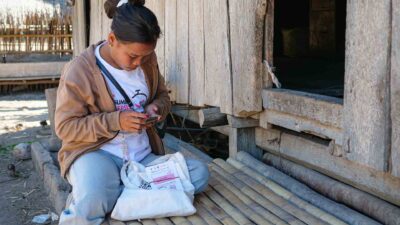
This new Immagine del giorno shows a Kawan Sehat community health worker walking through a village with her medical backpack. She carries nearly 100 items, including medicines, a blood-pressure monitor, basic medical equipment, and materials for prevention and health education. Here, care begins on foot.
A community health worker on foot: The path in the photograph is part of the work. Reaching a household can mean walking in the sun, carrying what is needed to assess a person, give basic first-contact care, explain what to watch for, and decide when referral is necessary. There is no waiting room here. Care starts where people live.
For the 27 Kawan Sehat agents, the backpack is not simply a bag of medicines. It is a practical clinical tool. It helps them respond to common problems, check basic parameters, manage simple wounds within their scope, support treatment adherence, and recognise danger signs requiring faster medical evaluation.
What the medical backpack carries: Medicines matter, but prevention matters as much. During a household visit, the same community health worker can discuss malaria, hygiene, nutrition, smoking, infectious-disease risk, or proper medicine use. Information given early, in a context people understand, can reduce delays before care and help families recognise when a problem is becoming serious.
This is why Kawan Sehat is part of Primary Medical Care rather than a medicine-distribution programme. Prevention, basic care, surveillance, education, and referral work together. The backpack, field training, and the Kawan Sehat application are different parts of that same system.
Primary care before the clinic: Community health workers do not replace nurses, doctors, laboratories, or hospitals. Their role is different. They bring trained observation and basic care closer to people who may otherwise have little practical access to it, then connect them to higher levels of care when needed.
Fair Future Foundation and Kawan Baik Indonesia built this programme around that reality. In remote East Sumba, distance shapes health outcomes. The woman in this photograph carries medicines, equipment, and knowledge, but also something very concrete. A health problem can be seen earlier, explained clearly, and acted on before it becomes harder to treat.
Today, August 25th 2026 – Alex Wettstein
Per ulteriori informazioni
- World Health Organization | Primary health care: WHO explains primary health care as prevention, treatment and support delivered as close as possible to people’s everyday lives and communities.
- World Health Organization | Integrating community health workers: WHO offers a practical framework for integrating community health workers into health systems through training, governance, supervision and evaluation.
- World Health Organization | Global curriculum guide for community health workers: WHO sets competency-based guidance for community health worker education, helping programmes match training to local roles, needs and health systems.
- WHO Indonesia | Health at the doorstep: WHO Indonesia documents integrated primary care moving services closer to villages through health centres, cadres, prevention and follow-up.
- UNICEF | Community health: UNICEF shows how trained community health workers extend health, nutrition and prevention services to children and families in hard-to-reach areas.
- CDC | Resources for Community Health Workers: CDC provides practical resources for community health workers, including training, chronic disease prevention and links to health and social services.
- PATH | Community health workers and digital innovation in Indonesia: PATH documents digital tools for community health workers in Indonesia, linking home visits, early warning, referral and stronger primary care.
- Indonesia Ministry of Health | Integrated Primary Care: Indonesia’s Ministry of Health describes integrated primary care that strengthens health cadres, home visits, prevention and early detection.