This image is in 1920×1080 resolution. Click on it to enlarge and view at full size.
When age limits mobility, primary healthcare still has to reach the home in East Sumba
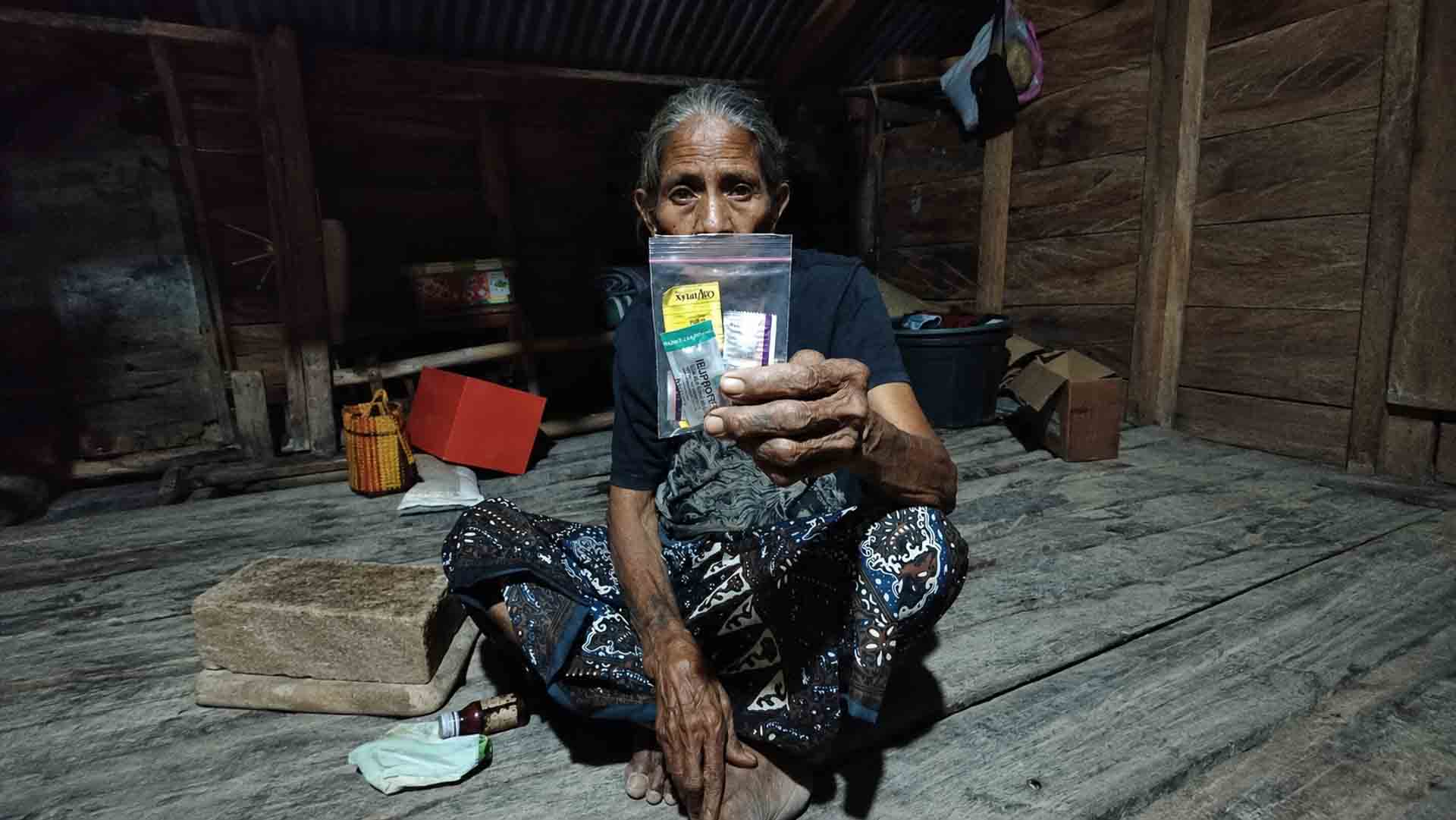
Questa nuova Foto della Giornata shows an older woman seated on the wooden floor of her home, holding a small packet of medicines. It is a simple image, but it says something important about elderly healthcare in East Sumba. When age, pain and reduced mobility make travel difficult, care has to come closer to the person.
Elderly healthcare in East Sumba at home
Children and older adults are among the people we see most often through Primary Medical Care. Older age can bring several problems at once, including chronic disease, joint pain, reduced strength, impaired mobility and difficulty reaching care. Poverty and distance add another layer. In some families, a person who can no longer work in the fields or rice paddies spends most of the day at home, and illness may remain untreated too long.
This is where Kawan Sehat agents matter. They live close to the people they serve. They listen, assess symptoms within their training, look for warning signs, provide basic treatment and medicines when appropriate, explain safe use, and identify when referral is needed. They do not replace doctors. They shorten the distance between the patient and the health system.
Il nostro portrait of an older man in Mbajik offers another perspective on listening to older people before speaking about care.
More than a packet of medicines
What the woman holds toward the camera is visible. What is not visible is the time behind it. A consultation means questions, observation, explanation and advice adapted to daily life. For an older patient who may have several conditions or medicines, that time matters. Pain relief, wound care, hydration advice, infection warning signs, blood pressure follow-up or referral each require a different decision, not simply a tablet.
Primary care is also continuity. Kawan Sehat agents can return, ask what changed, renew essential supplies, and contact the medical team when a situation exceeds their role.
Care must include those who stay home
Age must not make a person’s symptoms less important. Vulnerability grows when frailty, chronic illness, poverty, isolation and limited transport accumulate. For Fair Future Foundation and Kawan Baik Indonesia, medical backpacks, medicine stocks, training, supervision and field logistics make this care possible.
This photograph is quiet. An older woman, a wooden room, one small bag of medicines. But this is what elderly healthcare in East Sumba can look like when the clinic is far away and walking there is no longer simple.
Today, The 4th of September 2026 – Alex Wettstein
Per ulteriori informazioni
- World Health Organization – Ageing and health: Explains how ageing affects physical and mental capacity and why person-centred health and social systems must respond across later life.
- World Health Organization – Integrated care for older people: Provides practical pathways for primary and community care to assess older people, identify needs and build individualised care plans.
- World Health Organization – Community health worker programmes: Sets evidence-based principles for training, supporting and integrating community health workers into effective primary healthcare systems.
- WHO Indonesia – Primary health care: Frames primary healthcare in Indonesia and the Western Pacific around equitable, integrated care delivered as close as possible to daily life.
- Ministry of Health Republic of Indonesia – Older people: Describes Indonesia’s approach to health in later life, including prevention, screening, rehabilitation, medicines and long-term care support.
- HelpAge International – Health and care: Provides community-based resources on healthy ageing, caregiving and training volunteers to meet older people’s health and support needs.
- United Nations DESA – Health inequalities in old age: Examines how age, income, location and accumulated disadvantage can create unequal access to appropriate and affordable care in later life.