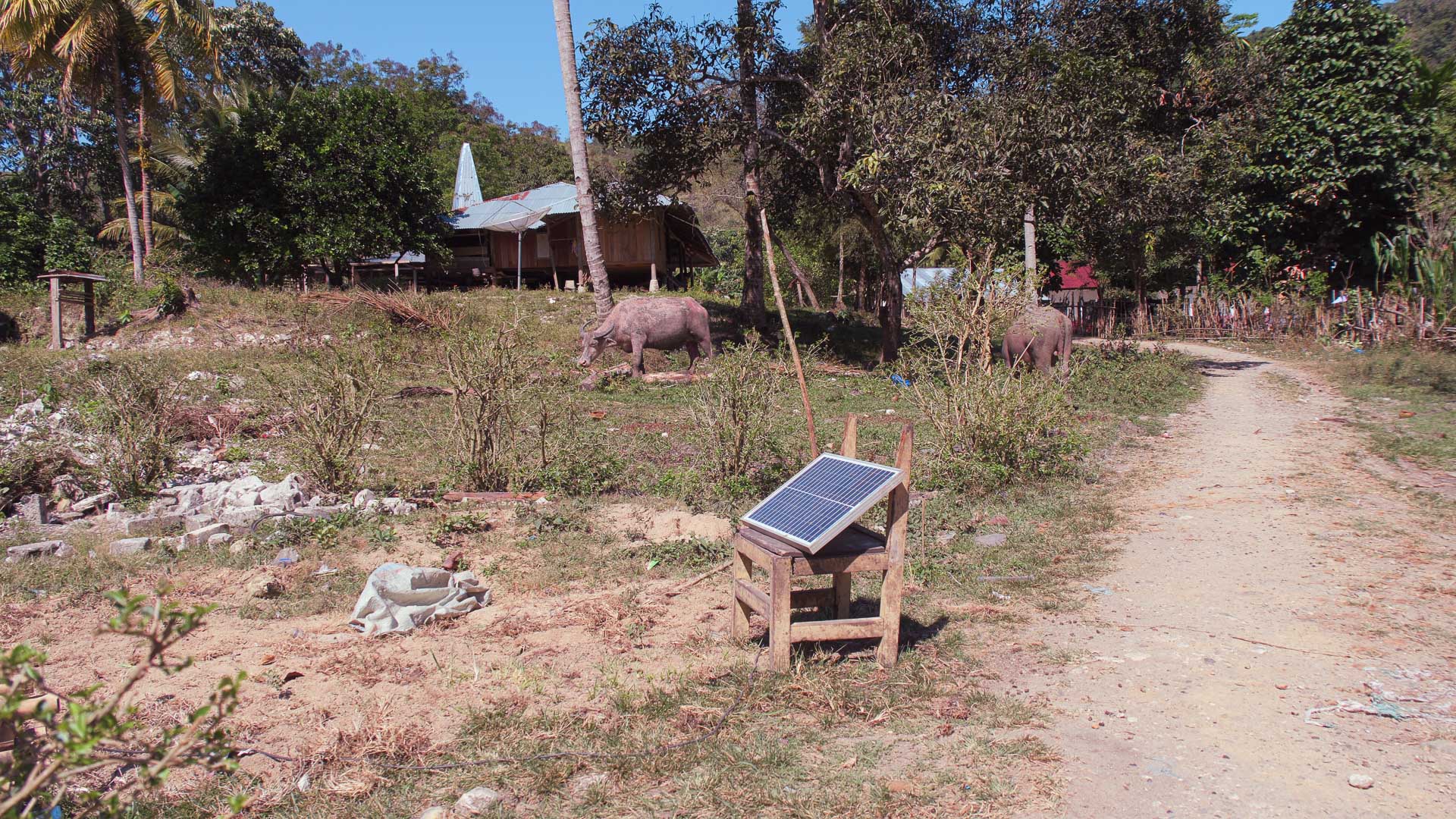
This image is in 1920×1080 resolution. Click on it to enlarge and view at full size.
Un piccolo pannello solare e una lampada in un villaggio senza elettricità Mahu
Questa nuova Foto della Giornata shows a small solar panel propped on a wooden chair beside a dirt road in Mahu, East Sumba. Two buffalo graze near the houses behind it. The old scooter battery it charges is outside the frame; inside a home, that stored power runs a single 12-volt lamp. This is what electricity access in Mahu can look like where the village has no grid connection.
Electricity access in Mahu begins with one lamp
I took this photograph last week because the arrangement says so much without showing a finished installation. Someone has placed the panel in the sun and made use of a battery that still holds enough charge for a little light. At night, that lamp means a person can see inside the house. It is a practical answer made with what was available.
It is also a very small amount of electricity. We should not assume this panel powers a phone, a school or medical equipment. If the battery fails or the weather changes, the light may not be there. A household deserves a system designed for its needs, installed safely and maintained over time.
What dependable power makes possible
With a properly sized supply, a family can have reliable lighting and charge a phone. A charged phone may help someone contact a health worker or arrange transport, if a signal is available. A school can use light and basic learning tools. Health teams need electricity for communication, lighting and appropriate devices. Each use requires a different amount of power; one old scooter battery cannot be asked to carry them all.
Fair Future Foundation and Kawan Baik Indonesia are working on solar and electrification for remote villages and schools. At SDN Mbajik, our teams have installed and evaluated a school solar system. Here in Mahu, this modest panel reminds us to begin with what people are already doing and listen to what they need next.
The scale of a useful solution
The chair, the panel, the quiet road and the grazing animals belong to an ordinary day. The battery is unseen, but the household’s effort is real. Our task is to move from a single lamp that might work tonight to electricity that people can rely on tomorrow, with local skills to keep it working.
25 September 2026 | Alex Wettstein
Per ulteriori informazioni
- Organizzazione Mondiale della Sanità: Explains why reliable electricity is needed for safe health services and how solar systems can support lighting, communications and essential care.
- UNICEF: Shows how renewable electricity supports schools, health facilities and water systems, with attention to maintenance and the needs of children.
- UNDP Indonesia: Documents off-grid solar work in remote Indonesian villages and the training of local operators needed to keep community systems working.
- World Bank Lighting Global: Describes quality-verified off-grid solar products for remote households and why dependable lighting requires more than a one-time installation.
- Sustainable Energy for All: Reviews delivery models for solar power in rural schools and health centres, including the maintenance and local capacity that make access last.