Two days in the village of Kabanda to assess the primary medical care program in one of Indonesia’s poorest, inaccessible and isolated villages.
A vital and necessary medical program, which we introduced more than four months ago now, and which is a fundamental human success. Nearly 800 suffering people, children injured or suffering from malaria, have been cared for and treated successfully by the health workers we trained.
Hello everyone from Rumah Kambera, Sumba Timur,
As we presented in one of our last articles, the last week of March is the first week of April 2023; our teams went to five ultra-rural villages to evaluate die PMC (Primary Medical Care Programm) Für die Gemeinschaften und die Dorfbewohner. Während seiner Besuche führten wir den Blutdruckmonitor-Programm auch Menschen mit hohem Blutdruck vor. Sie können den Artikel dazu hier lesen.
Die fünf ländlichen Dörfer, die wir fast eine Woche lang besuchten, gehören zu den am weitesten entfernten und isoliertesten in der Region und Indonesien. Die fünf Dörfer, die wir gesehen oder wieder besucht haben, sind: Mbinudita, Mbatapuhu, Kabanda, Mahu und Lapinu. These are villages that are categorized as being “in pain”. That are places where people don’t eat and drink enough and can’t wash and care for themselves because they don’t have enough water. Here people live with less than 2 litres of water per person daily to do everything.
Diese Dörfer haben keinen Zugang zu Strom, Wasser oder direkter medizinischer Versorgung; wir besprechen dies oft. Im Durchschnitt ist das nächstgelegene Gesundheitszentrum mit einem motorisierten Fahrzeug mehr als drei Stunden entfernt von allen Wohnhäusern. Aus diesen wenigen Gründen haben wir insbesondere folgende Maßnahmen eingeführt: -mit unseren medizinischen Freunden und Sozialpartnern- the primary medical care program for regions and populations from the ultra-rural areas in east Indonesia. As part of this article, we will show you and explain what we did in Kabanda:
Kabanda is genuinely one of the most isolated I have ever seen. Getting it is difficult, even dangerous, at times. No road leads to this village; only extremely steep or steep stony paths allow us to go there. It took us over six hours to get there, including four hours of absolute terrain with the Truck of Life, a 4×4 medical truck specially designed for this journey. Kabanda is no exception; so many villages are in the same situation: That is to say, they have no road leading there. This raises – among other things – the question of access to health care, of course. And it is for these types of communities that Fair Future exists, and together with our friends from Gute Freunde, Sumba Volunteer und Charis Foundation, we have created this primary medical care program.
Here, when a person is sick or injured when a woman has to give birth, one of the only ways for her to receive medical care is to carry her on the backs of people, and this for several hours, even an entire day, to the nearest healthcare centre. This person is also unsure about arriving at the care centre, called “Puskesmas or Pustu”.
We will tell you an example of life in these villages isolated from everything, including medical care centres:
This story happened about a fortnight ago in a tiny village near Kabanda. A woman living in one of the houses here was pregnant with her first child. This woman was over eight months pregnant when suddenly, she no longer felt any fetus movement in her womb. Panicked, she and her husband visited the nearest medical centre (Puskesmas). From these houses and these villages, there is no good path and, of course, no road. Families very rarely have a scooter and no car. Therefore, several people decided to transport this suffering woman, seized with terrible abdominal pain, to the nearest Puskesmas. Reaching this health centre usually takes three to four hours of walking. This medical event happened at the end of the day; it was already dark and raining hard. The paths were very steep, so the water ran down them hard, making them slippery. Standing, walking, and moving around while carrying a suffering person at arm’s length was tricky. And we still had to cross three rivers whose current had increased because of the falling rain.
After almost eight hours of walking, this woman and the people who carried her could reach the small Mahu health centre; her baby had died. She suffered from significant medical complications during the trip, deteriorating her health.
This is what life can be like for people with medical conditions who don’t have access to direct medical or healthcare. For example, we have hundreds of those related to illnesses, injuries, Malaria, Dengue fever, asthma attacks, bites, or burns. Most of the time, these needy people cannot get to a care centre in time. They will stay home and (maybe) self-medicate.
Three young women, three teachers, three Kawan Sehat agents, and three people who save lives. Three superheroines! Their names are Merlin, Siyane and Sarlota.
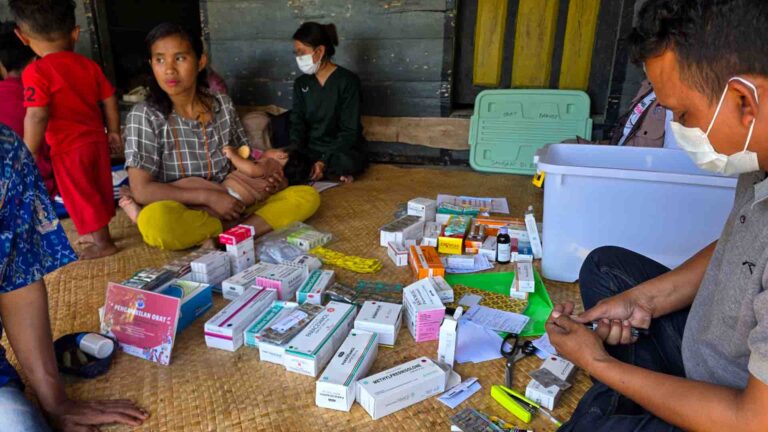
In the company of the three health workers “Kawan Sehat” of this village, we lived a day (in fact, two days) more than extraordinary. These three women? It’s just three superheroes! They told us how they had experienced all this care for young and sick patients, injured or ill children, feverish or suffering from Malaria, and how they had reacted, treated, and cared for them.
Merlin, Siyane and Sarlota also asked us how this drug works, how to treat this or that problem, and the best behaviour to adapt to a patient with X symptoms. They also told us of their great pride in that of three women between the ages of 25 and 30 who suddenly took on responsibilities and importance in their village.
Grundsätzlich kümmern sich hier, und in Bezug auf die lokale Kultur und Traditionen, Frauen um die Hausarbeit, Wasser holen, für die Kinder kochen und die Familie versorgen. Diese drei weiblichen Superheldinnen sind nicht nur Lehrerinnen im Rahmen von Charis Sumba, sondern sie sind nun auch – und schon seit mehr als vier Monaten – die Gesundheitsarbeiter des PMC-Programms. Sie sind diejenigen, die in Abwesenheit eines medizinischen Zentrums, medizinischer Versorgung oder eines Arztes im Dorf ein Leben retten können. Dies ist keine Verbesserung der Rolle der Frauen in ultra-ländlichen Dörfern; es ist ein immenser und wichtiger Fortschritt.
Und wie wir es in dem Dorf getan haben Mbinudita und Mabatapuhu, we gave new prerogatives to these two Kawan Sehat Agents: Since April, here in this village of Kabanda, Merlin, Siyane und Sarlota can measure the blood pressure of a patient, and in case of hypertension, to give appropriate medical treatment. It is a social and medical revolution, in our opinion. You can read much more about this program here too.
Alexandre Wettstein aus dem Medizinsozialen Camp der Stiftung in Ost-Sumba, Rumah Kambera, Lambanapu, on April 20th, 2023.