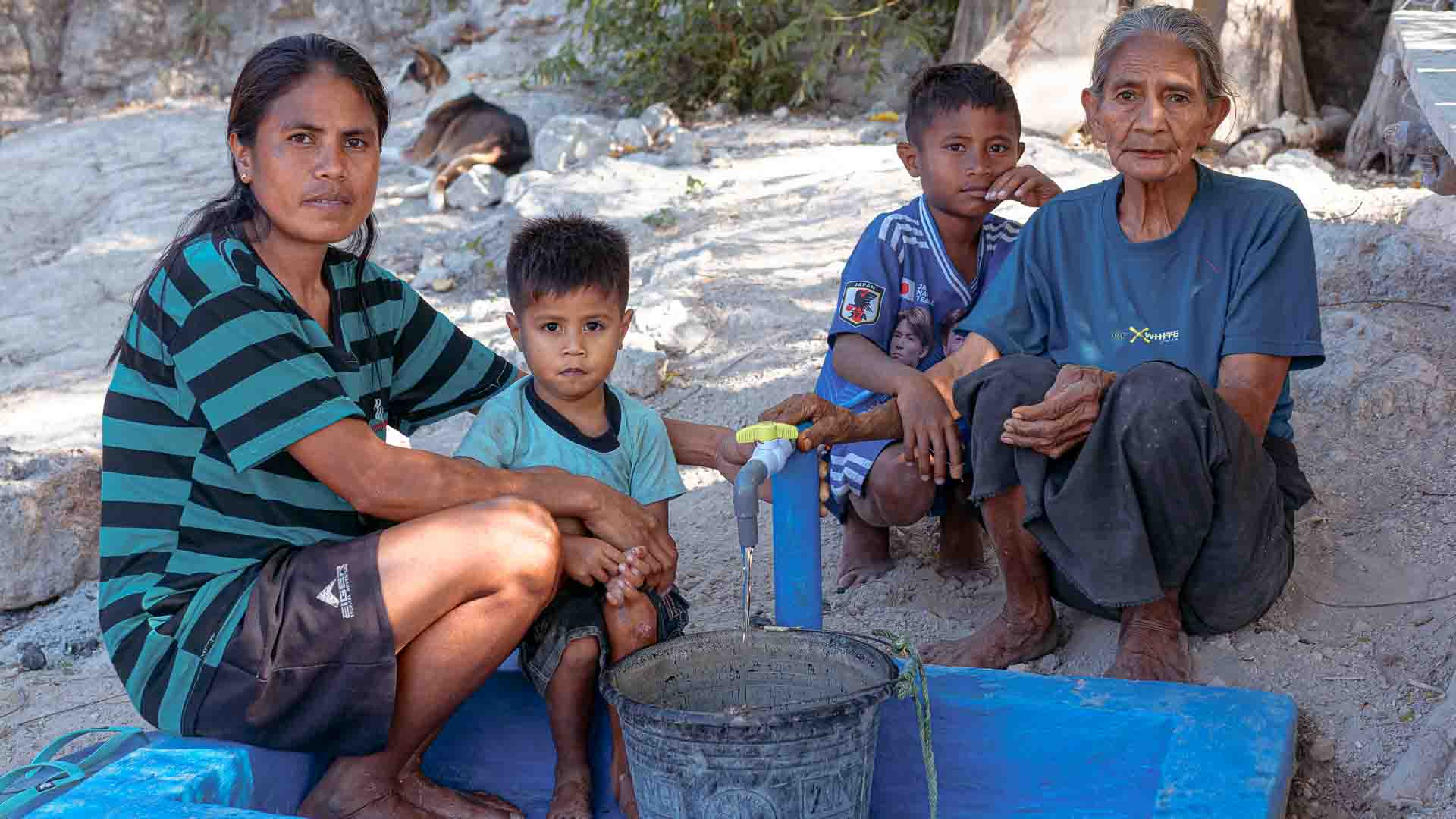
This image is in 1920×1080 resolution. Click on it to enlarge and view at full size.
Clean water at home from a 5,300-litre gravity-fed reservoir
This new Immagine del giorno shows clean water at home becoming a reality. A tap is open. Water falls into a bucket while two women and two children sit beside it. For the two families living here, around fifteen people, this small flow changes daily life.
Clean water at home improves health: The water flows by gravity from a new 5,300-litre reservoir installed higher on the hill. Around 200 metres of pipe carry it downhill to several houses. No pump is needed at the tap. Water can now be collected where people live, for drinking, cooking, handwashing, bathing, cleaning utensils and caring for children.
When water is safe, available and properly stored, the health benefits are substantial. It supports hydration and safer food preparation. It makes handwashing practical rather than theoretical. It reduces reliance on more contaminated sources and can lower exposure to diarrhoeal and other waterborne infections. By helping prevent repeated diarrhoea, safe water also protects nutrition, especially in children.
Prevention begins before the clinic: Piped water does not prevent malaria on its own. Malaria prevention still depends on effective vector control, insecticide-treated nets where indicated, early testing and treatment. But good water management matters. Closed storage, drainage and avoiding standing water around taps and tanks help prevent new mosquito breeding sites and can support wider vector-control measures.
For older people, children and anyone weakened by illness, having water close to the house can reduce the physical burden of collecting it. It can also free up time for food preparation, childcare, school,l and work.
Water Connections is preventive medicine: This is why Fair Future Foundation e Kawan Baik Indonesia treat Water Connections as part of the health system, not as a separate construction project. Clean water at home is primary prevention because health starts with the conditions that determine whether people become sick.
We often say that clean water is the least expensive medicine. Not because water treats an infection once it has started, but because safe, accessible water reduces exposure before illness begins. In this photograph, that principle is visible in one open tap, one bucket and water arriving directly at home.
Today, the 18th of August 2026 – Alex Wettstein
Per ulteriori informazioni
- World Health Organisation | Drinking-water: WHO explains how safe and readily available drinking water protects health and reduces exposure to diarrhoeal and other preventable diseases.
- World Health Organisation | Small water supplies: WHO guidance for small water systems focuses on water safety, resilient service delivery and reducing waterborne disease in vulnerable communities.
- WHO and UNICEF | Mosquito-borne disease and WASH: WHO and UNICEF explain how Water, sanitation, drainage and waste management can help prevent mosquito-borne disease without replacing core control.
- World Health Organisation | Malaria: WHO summarises malaria transmission, prevention, diagnosis, and treatment, clarifying why household water does not replace core malaria control.
- UNICEF Indonesia | Water, sanitation and hygiene: UNICEF Indonesia links safe Water, sanitation and hygiene with child health, dignity and protection from disease in communities across Indonesia.
- CDC | Global WASH: CDC outlines how unsafe water, poor sanitation and inadequate hygiene contribute to diarrhoeal disease and other preventable health risks.
- UN-Water | WHO WASH Strategy 2026-2035: UN-Water presents WHO’s 2026-2035 WASH strategy, linking safe management of water and sanitation services directly to better health outcomes.
- WaterAid | Timor-Leste: WaterAid describes rural Water, sanitation and hygiene work in nearby Timor-Leste, including hard-to-reach communities and stronger local systems.