


Spenden
Support Care
Artikel & News
Feldgeschichten
Glossar
Feldführer
Gesundheitsprogramm
Kawan gegen Malaria
Year-round malaria prevention, parasite-based diagnosis, treatment support and vector control with families across remote East Sumba.
- Active across East Sumba since 2022
- Thousands of insecticide-treated nets distributed
- Hundreds of homes protected through IRS
Malaria control must continue after a campaign leaves
In remote East Sumba, exposure, fever and delayed access are part of daily life. Since 2022, Kawan Against Malaria has worked with families throughout the year: preventing bites, testing suspected cases, supporting appropriate treatment and recognising when a patient needs urgent referral.
Das Programm
A continuous malaria programme built around families
Malaria is preventable and curable, but the first symptoms can resemble many other infections. A patient needs observation, a parasite-based test and timely clinical decisions, not treatment based on fever alone.
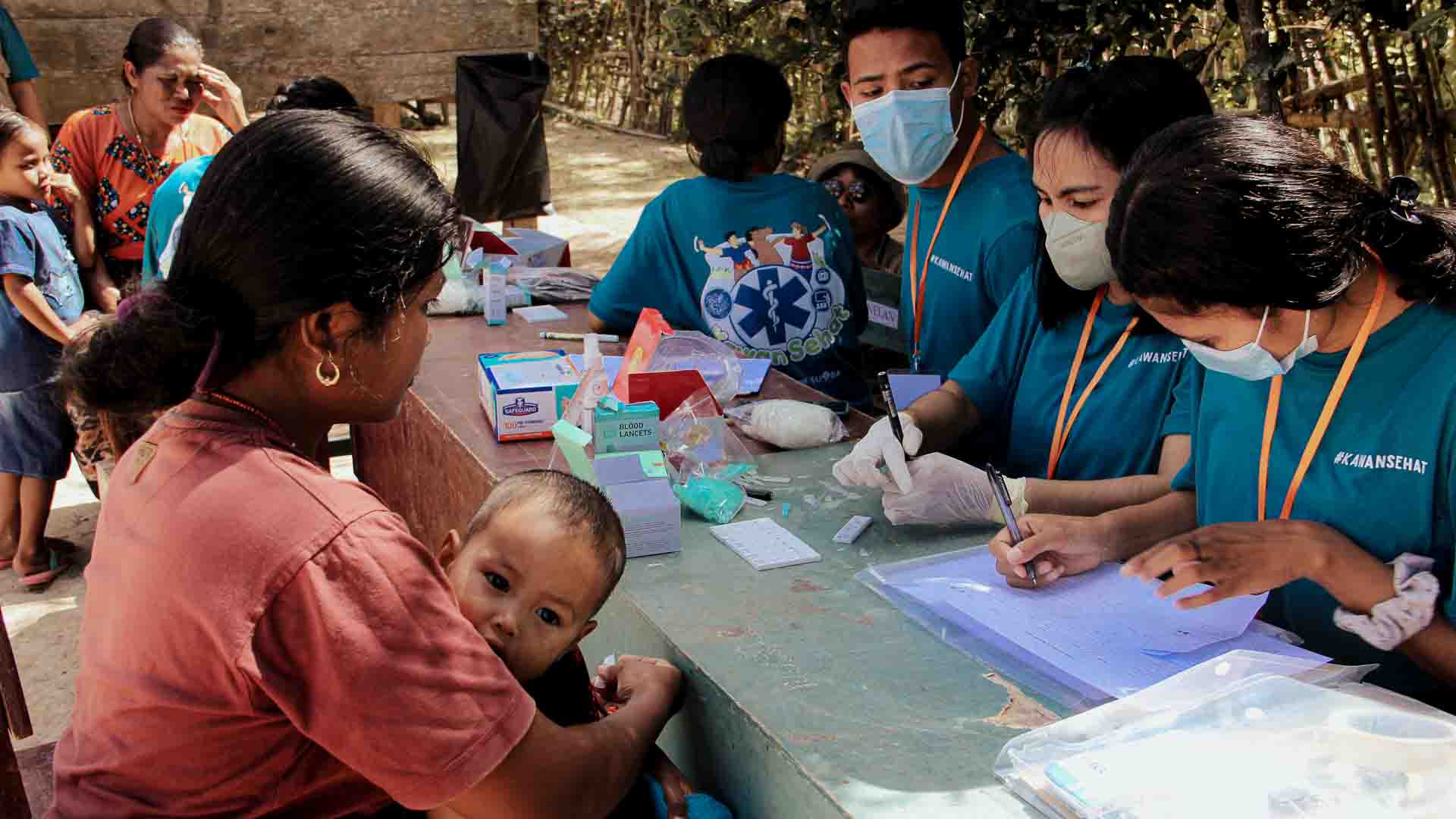
Since 2022, Kawan Against Malaria has brought prevention and clinical action into remote villages. Kawan Sehat agents meet people at home, assess fever, support rapid testing, explain results, follow patients and refer danger signs. During community medical days, teams add broader clinical assessment, malaria screening, microscopy where available, medicines, prevention education and follow-up.
The programme also acts before anyone becomes ill. Thousands of insecticide-treated nets have been distributed, hundreds of homes have received indoor residual spraying, and families learn how to reduce exposure, recognise symptoms and seek testing early. The 2025 Umalulu study is one carefully documented part of this wider programme. It helps measure household risk and refine future action; it does not define the programme on its own.
Prevention, testing, treatment support, training, surveillance and referral continue throughout the year.
Repeated village actions combine net distribution with practical teaching on correct use, care, repair and replacement.
Indoor residual spraying is carried out as part of wider vector-control work by trained teams following safety protocols.
Kawan Sehat agents and community medical teams assess fever, support parasite-based diagnosis and follow patients in remote villages.
From suspected malaria to safer care
A fever must move through a reliable clinical pathway
Early action matters, but speed without diagnostic discipline can miss malaria, overlook another serious infection or expose a patient to the wrong medicine.
Recognise possible malaria
Fever, chills, headache, weakness and recent exposure are taken seriously, with particular caution for young children, pregnant women and people who are already fragile.
Confirm the parasite
A rapid diagnostic test or microscopy is used whenever available. Parasite-based diagnosis guides treatment and helps avoid treating every fever as malaria.
Assess severity
Consciousness, breathing, hydration, repeated vomiting, convulsions, jaundice, bleeding and the ability to drink help determine whether referral is urgent.
Treat or refer safely
Confirmed uncomplicated malaria follows approved national protocols through qualified services. Severe disease, uncertainty or unavailable treatment requires rapid referral.
Follow up and protect
Recovery, medicine completion and recurring fever are reviewed while the household receives practical support on nets, mosquito exposure and when to seek care again.
Fever is not a diagnosis
Local action must remain clinically safe
The programme brings prevention and diagnostic access closer to families while keeping clear limits. Severe malaria can progress rapidly, and other dangerous infections may begin with the same fever.
What the programme can do safely
- Document fever history, exposure, previous treatment and household risk
- Teach early symptoms, danger signs and when waiting is no longer safe
- Provide and demonstrate correct use and care of insecticidal mosquito nets
- Support rapid testing and microscopy through trained health personnel
- Carry out indoor residual spraying under controlled safety protocols
- Connect confirmed or worsening cases to treatment, referral and follow-up
When urgent referral is required
- Altered consciousness, repeated convulsions, collapse or extreme weakness
- Difficulty breathing, shock, severe pallor or suspected severe anaemia
- Inability to drink, persistent vomiting or signs of severe dehydration
- Jaundice, dark or bloody urine, abnormal bleeding or rapidly worsening illness
- Fever in a very young child, during pregnancy or in a highly vulnerable patient
- Any suspected malaria when testing, appropriate treatment or safe monitoring is unavailable
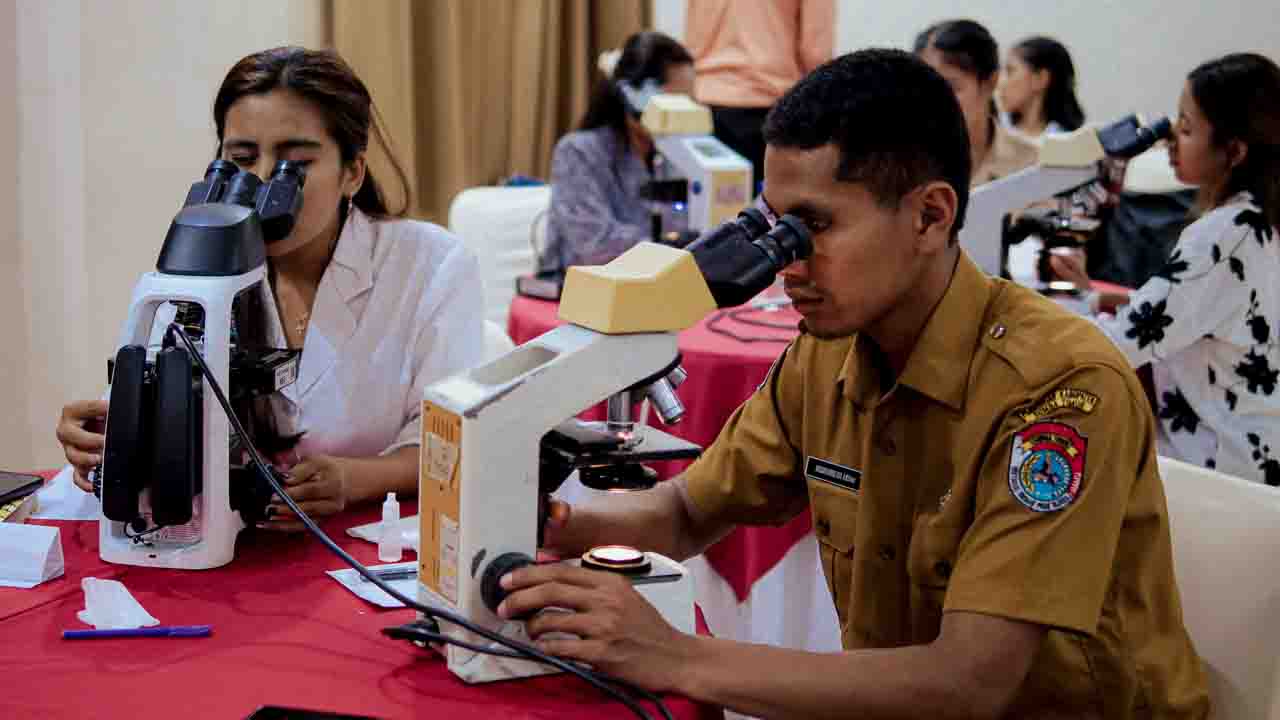
A diagnosis is not a device alone. It depends on correct sampling, slide preparation, reading, recording, clinical interpretation and a treatment pathway that the patient can actually reach.
The diagnostic and prevention chain
Every tool must lead to a safer decision
Rapid tests, microscopes, mosquito nets and sprayers only protect people when training, quality control, clear protocols, stock management and follow-up remain connected. Kawan Against Malaria builds that chain with local teams rather than delivering isolated equipment.
Household knowledge
Families learn how malaria is transmitted, how to use and repair nets, where mosquitoes breed and which symptoms require testing.
Parasite-based diagnosis
Rapid diagnostic tests support early decisions, while microscopy strengthens species identification, parasite detection and laboratory capacity.
Vector control
LLIN distribution and indoor residual spraying are documented, explained and adapted to the condition of each household.
Treatment and follow-up
Confirmed cases are connected to approved treatment and reviewed for deterioration, recurring fever, adherence and referral needs.
Welche Änderungen in der Praxis
Malaria control becomes local, measured and repeatable
Fewer fevers are treated blindly
Testing separates confirmed malaria from other causes of fever and directs patients towards more appropriate care.
Protection fits the household
Net condition, sleeping spaces, wall surfaces, behaviour and exposure are observed before prevention is planned.
Severe disease is recognised earlier
Families and local agents share a practical language for danger signs, urgent referral and the limits of home care.
Local data changes the next action
Household evidence, test results and field records guide training, supplies, vector control and follow-up instead of assumptions.
Complete field reportThe full Umalulu reportOpen the complete report, including household evidence, field observations and action priorities from the 2025 study.
Scientific reportIMRaD methods and resultsOpen the scientific version covering methodology, findings, discussion, limitations and public-health implications.
Field resultsEast Sumba prevention in practiceSee how education, LLINs, IRS, diagnostics and village partnerships were delivered and documented.
Diagnostic capacityMicroscopy training and validationFollow the practical work of preparing, reading and discussing malaria slides with local laboratory teams.
Live FeldaufzeichnungFeldbesprechung aus OstindienRead current observations from testing, prevention sessions, household work and the realities teams meet in remote villages.
Feldhandbuch & GlossarMalaria terms explainedOpen practical explanations of RDTs, microscopy, LLINs, IRS, parasites, referral and community surveillance.
Medizinisches ReferenzmaterialWHO guidelines for malariaConsult the current evidence-based recommendations for diagnosis, treatment, prevention, vector control and surveillance.
Live aus dem Feld
Kawan Against Malaria Field Notes, as the work happens
Two recent field signals from testing, microscopy, household prevention, mosquito-net use or vector control. These notes refresh when a relevant Field Note is published.
Direkt vom Feld
Latest Kawan Against Malaria reports
These reports follow the continuing programme: fever assessment, rapid tests, microscopy, treatment support, LLIN distribution, indoor residual spraying, education, referral and the limits teams meet in remote villages.

Truck of Life Die Mission von s: Indonesiens vergessene Regionen
Mit lebensrettenden Medikamenten, Diagnostika und Hoffnung vollgepackt, geht Fair Future Truck of Life auf seine nächste lebenswichtige Reise. Dies ist nicht nur ein Lastwagen; es ist eine Rettungsleine auf Rädern, die gefährliche Straßen zurücklegt, um Gemeinden in den abgelegensten Regionen Indonesiens zu erreichen.

Spenden Sie jetzt: Hilfe #ZeroMalaria mit zwei neuen Mikroskopen
Schließen Sie sich uns an bei einer dringenden Initiative, die die tödliche Malaria-Epidemie in Ostindonesien gezielt bekämpft. Erfahren Sie, wie Olympus-Trinokularmikroskope eine entscheidende Rolle bei der präzisen Diagnose dieser Krankheit spielen und warum sie unverzichtbar sind. Ihr finanzieller Beitrag kann diese entscheidenden Geräte beschaffen, was die Reduzierung der Sterblichkeitsraten direkt beeinflusst…

Daniel kämpft gegen Malaria: #ZeroMalaria Programm von Fair Future
Im abgelegenen Dorf Lulundilo wurde ein junger Junge namens Daniel mit Malaria diagnostiziert. Aufgrund des eingeschränkten Zugangs zu Gesundheitsversorgung sind die Konsequenzen enorm. Verfolgen Sie die strengen Einsatzmaßnahmen von Fair Future Foundation’s durch ihr #ZeroMalaria Programm, das nicht nur eine sofortige Behandlung bietet, sondern auch die Gemeinden für eine…

Report von ZeroMalaria: Der anhaltende Kampf um die Malariabekämpfung in Ost-Sumba
Der „ZeroMalaria“-Bericht von Fair Future beleuchtet den effektiven, aber anhaltenden Kampf der Organisation gegen Malaria in Ost-Sumba. Die vielschichtige Herangehensweise umfasst die Bereitstellung sauberer Wasserinfrastrukturen, Schulung der Bevölkerung und Stärkung der Selbstständigkeit. Erfahren Sie, wie diese Bemühungen einen greifbaren Unterschied bewirken und gleichzeitig die lange Reise vor uns darstellen.

Malariaprevention: ein pädagogisches Instrument, das Leben rettet
Ein Plakat zur Malaria-Erziehung hilft Familien im ländlichen Osten von Sumba, die Prävention, Symptome und praktische Schutzmaßnahmen zu verstehen. Es unterstützt die Gesundheit der Gemeinschaft dort, wo der Zugang zu medizinischer Versorgung eingeschränkt ist.

Die Malaria-Epidemie bekämpfen: transformative Gesundheitslösungen für Ostindonesien
In ultra-ländlichen Regionen in Ostindonesien ist Malaria mehr als eine Krankheit; es ist ein systematisches Problem, das die Entwicklung der Gemeinden behindert. Fair Future Foundation Das #ZeroMalaria Programm von s geht dieser Krise mit einem einzigartigen, umfassenden Ansatz direkt entgegen. Von präventiver Bildung über die Bereitstellung sofortiger medizinischer Hilfe ist unser Ziel, die Kette der…

Zero Malaria Die Aufkleber, die Leben retten in East Sumba
Fair Future verwendet Behandlungsstickers, um besprühte Häuser zu identifizieren und die Bildung der Bevölkerung im Rahmen der Malariabekämpfung in East Sumba zu unterstützen.

Die #ZeroMalaria Mission: Die Bevölkerung von Ost-Sumba unter extremen Bedingungen testen
Begib dich auf eine Reise mit dem bahnbrechenden #ZeroMalaria Programm von Fair Future Foundation s, das darauf abzielt, Malaria in Ost-Sumba, Indonesien, auszurotten. Diese ehrgeizige Initiative zielt darauf ab, mindestens 87% Einwohner der Region zu testen, selbst in den abgelegensten und schwierigsten Gebieten.

Im Hintergrund: Fair Future’s Bemühungen zur Malariabekämpfung in Ost-Sumba
Fair Future Foundation In Zusammenarbeit mit Kawan Baik und Sumba Volunteer setzt sich die Organisation für mutige Schritte ein, um Malaria in einer der am stärksten betroffenen Regionen der Welt zu eliminieren – Ost-Sumba in Indonesien. Dieses umfassende Programm zielt darauf ab, Zehntausenden von Menschen zu dienen und sich auf eine frühzeitige Diagnose und eine effektive Behandlung zu konzentrieren.

Die Schlacht von Rambu Mirna: Kampf gegen Malaria in abgelegenen Gebieten von Ost-Sumba
Begib dich auf eine tiefgreifende Reise mit Rambu Mirna, während sie in der Wildnis des abgelegenen Ost-Sumbas gegen Malaria kämpft – einem Gebiet, wo die Gesundheitsversorgung ein ferner Traum ist. Tauche ein in die bemerkenswerte Geschichte von Widerstand und Hoffnung und erfahre, wie Fair Future Foundation die #ZeroMalaria Initiative nicht nur Leben rettet, sondern ganze Gemeinschaften verändert.

Voluntäre: Die Grundlage für Zero Malaria Initiativen in Ost-Sumba
Im Kampf gegen Malaria in Ost-Sumba stehen Freiwillige an vorderster Front und verkörpern Hoffnung, Hingabe und gemeinschaftlich getragene Maßnahmen. Entdecken Sie, wie diese Alltagshelden, die an der #ZeroMalaria Initiative von Fair Future Foundation’mitwirken, das Landschaftsbild der öffentlichen Gesundheit verändern.

#ZeroMalaria Kampagne: Die lebensrettende Mission von Fair Future
Die Zero Malaria Kampagne von Fair Future kombiniert Tests, Datenerhebung, Prävention und Zugang zu Behandlung in abgelegenen Gemeinden im Osten von Sumba.
Verantwortung
Malaria control must remain measurable after the campaign leaves
We document households reached, tests performed, confirmed cases, nets distributed, surfaces sprayed, people trained, referrals made and gaps that remain. Kawan Against Malaria is not a one-day distribution. It is a continuing clinical and public-health process built with communities and local services.
