


Donare
Assistenza sanitaria
Articoli e News
Storie dal campo
Glossario
Guida escursionistica
Programma Salute e Medicina
Kawan Against Malaria
Year-round malaria prevention, parasite-based diagnosis, treatment support and vector control with families across remote East Sumba.
- Active across East Sumba since 2022
- Thousands of insecticide-treated nets distributed
- Hundreds of homes protected through IRS
Malaria control must continue after a campaign leaves
In remote East Sumba, exposure, fever and delayed access are part of daily life. Since 2022, Kawan Against Malaria has worked with families throughout the year: preventing bites, testing suspected cases, supporting appropriate treatment and recognising when a patient needs urgent referral.
Il programma
A continuous malaria programme built around families
Malaria is preventable and curable, but the first symptoms can resemble many other infections. A patient needs observation, a parasite-based test and timely clinical decisions, not treatment based on fever alone.
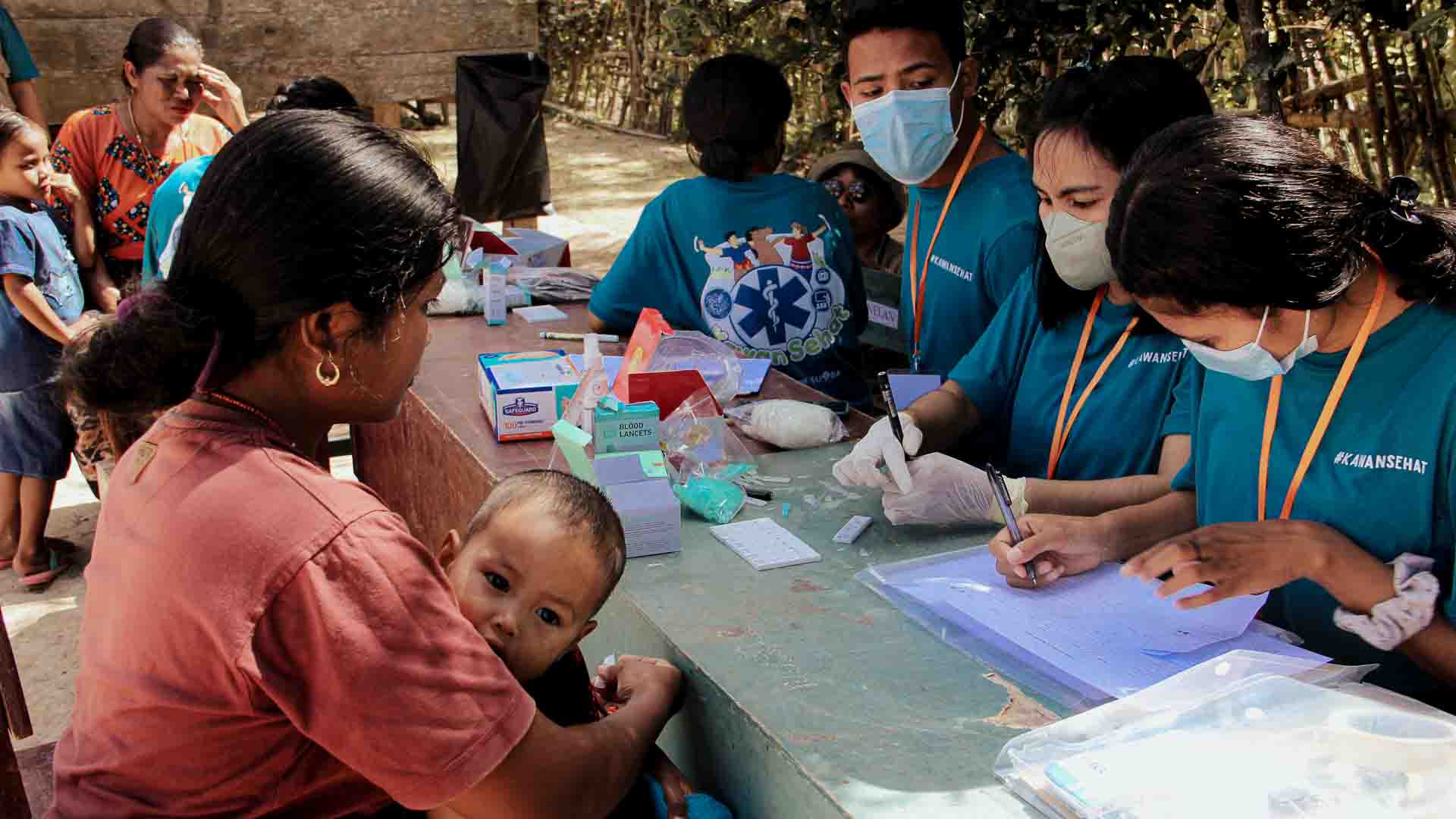
Since 2022, Kawan Against Malaria has brought prevention and clinical action into remote villages. Kawan Sehat agents meet people at home, assess fever, support rapid testing, explain results, follow patients and refer danger signs. During community medical days, teams add broader clinical assessment, malaria screening, microscopy where available, medicines, prevention education and follow-up.
The programme also acts before anyone becomes ill. Thousands of insecticide-treated nets have been distributed, hundreds of homes have received indoor residual spraying, and families learn how to reduce exposure, recognise symptoms and seek testing early. The 2025 Umalulu study is one carefully documented part of this wider programme. It helps measure household risk and refine future action; it does not define the programme on its own.
Prevention, testing, treatment support, training, surveillance and referral continue throughout the year.
Repeated village actions combine net distribution with practical teaching on correct use, care, repair and replacement.
Indoor residual spraying is carried out as part of wider vector-control work by trained teams following safety protocols.
Kawan Sehat agents and community medical teams assess fever, support parasite-based diagnosis and follow patients in remote villages.
From suspected malaria to safer care
A fever must move through a reliable clinical pathway
Early action matters, but speed without diagnostic discipline can miss malaria, overlook another serious infection or expose a patient to the wrong medicine.
Recognise possible malaria
Fever, chills, headache, weakness and recent exposure are taken seriously, with particular caution for young children, pregnant women and people who are already fragile.
Confirm the parasite
A rapid diagnostic test or microscopy is used whenever available. Parasite-based diagnosis guides treatment and helps avoid treating every fever as malaria.
Assess severity
Consciousness, breathing, hydration, repeated vomiting, convulsions, jaundice, bleeding and the ability to drink help determine whether referral is urgent.
Treat or refer safely
Confirmed uncomplicated malaria follows approved national protocols through qualified services. Severe disease, uncertainty or unavailable treatment requires rapid referral.
Follow up and protect
Recovery, medicine completion and recurring fever are reviewed while the household receives practical support on nets, mosquito exposure and when to seek care again.
Fever is not a diagnosis
Local action must remain clinically safe
The programme brings prevention and diagnostic access closer to families while keeping clear limits. Severe malaria can progress rapidly, and other dangerous infections may begin with the same fever.
What the programme can do safely
- Document fever history, exposure, previous treatment and household risk
- Teach early symptoms, danger signs and when waiting is no longer safe
- Provide and demonstrate correct use and care of insecticidal mosquito nets
- Support rapid testing and microscopy through trained health personnel
- Carry out indoor residual spraying under controlled safety protocols
- Connect confirmed or worsening cases to treatment, referral and follow-up
When urgent referral is required
- Altered consciousness, repeated convulsions, collapse or extreme weakness
- Difficulty breathing, shock, severe pallor or suspected severe anaemia
- Inability to drink, persistent vomiting or signs of severe dehydration
- Jaundice, dark or bloody urine, abnormal bleeding or rapidly worsening illness
- Fever in a very young child, during pregnancy or in a highly vulnerable patient
- Any suspected malaria when testing, appropriate treatment or safe monitoring is unavailable
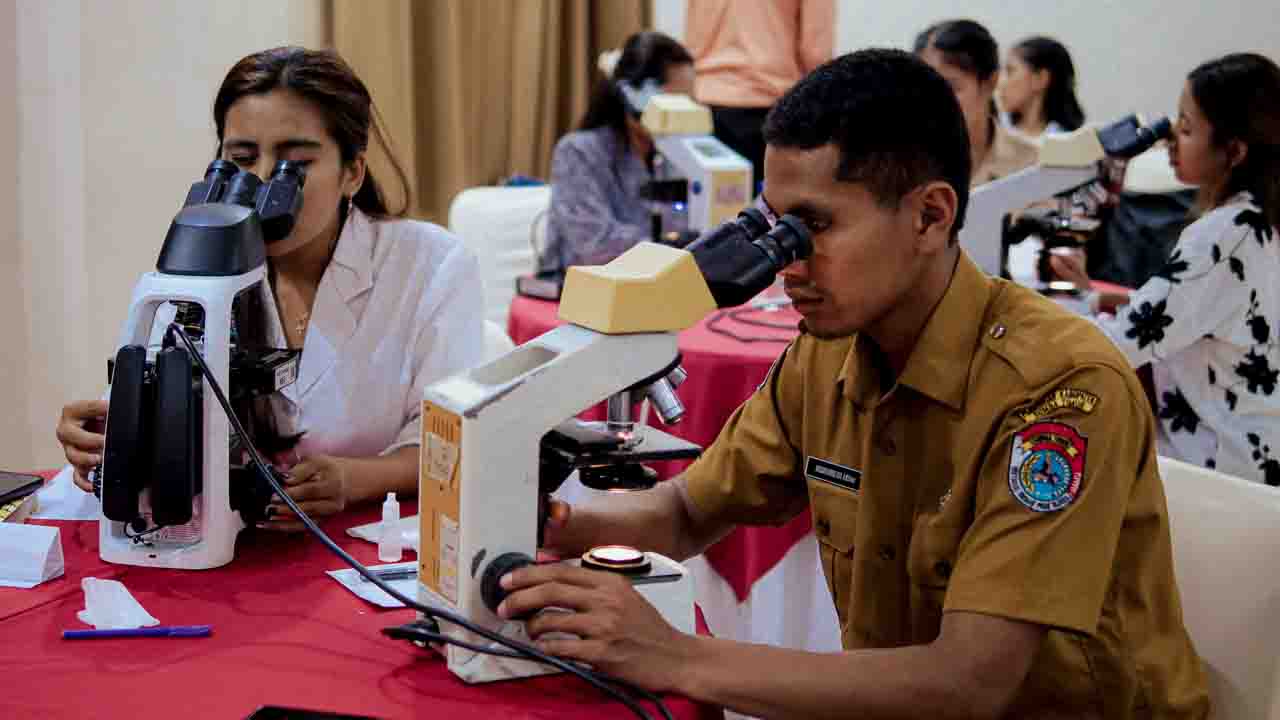
A diagnosis is not a device alone. It depends on correct sampling, slide preparation, reading, recording, clinical interpretation and a treatment pathway that the patient can actually reach.
The diagnostic and prevention chain
Every tool must lead to a safer decision
Rapid tests, microscopes, mosquito nets and sprayers only protect people when training, quality control, clear protocols, stock management and follow-up remain connected. Kawan Against Malaria builds that chain with local teams rather than delivering isolated equipment.
Household knowledge
Families learn how malaria is transmitted, how to use and repair nets, where mosquitoes breed and which symptoms require testing.
Parasite-based diagnosis
Rapid diagnostic tests support early decisions, while microscopy strengthens species identification, parasite detection and laboratory capacity.
Vector control
LLIN distribution and indoor residual spraying are documented, explained and adapted to the condition of each household.
Treatment and follow-up
Confirmed cases are connected to approved treatment and reviewed for deterioration, recurring fever, adherence and referral needs.
Quali cambiamenti nella pratica
Malaria control becomes local, measured and repeatable
Fewer fevers are treated blindly
Testing separates confirmed malaria from other causes of fever and directs patients towards more appropriate care.
Protection fits the household
Net condition, sleeping spaces, wall surfaces, behaviour and exposure are observed before prevention is planned.
Severe disease is recognised earlier
Families and local agents share a practical language for danger signs, urgent referral and the limits of home care.
Local data changes the next action
Household evidence, test results and field records guide training, supplies, vector control and follow-up instead of assumptions.
Complete field reportThe full Umalulu reportOpen the complete report, including household evidence, field observations and action priorities from the 2025 study.
Scientific reportIMRaD methods and resultsOpen the scientific version covering methodology, findings, discussion, limitations and public-health implications.
Field resultsEast Sumba prevention in practiceSee how education, LLINs, IRS, diagnostics and village partnerships were delivered and documented.
Diagnostic capacityMicroscopy training and validationFollow the practical work of preparing, reading and discussing malaria slides with local laboratory teams.
Registrazione in campo in tempo realeNote di viaggio dall'Indonesia orientaleRead current observations from testing, prevention sessions, household work and the realities teams meet in remote villages.
Guida pratica e glossarioMalaria terms explainedOpen practical explanations of RDTs, microscopy, LLINs, IRS, parasites, referral and community surveillance.
Referenza medicaWHO guidelines for malariaConsult the current evidence-based recommendations for diagnosis, treatment, prevention, vector control and surveillance.
In diretta dal campo
Kawan Against Malaria Field Notes, as the work happens
Two recent field signals from testing, microscopy, household prevention, mosquito-net use or vector control. These notes refresh when a relevant Field Note is published.
Direttamente dal campo
Latest Kawan Against Malaria reports
These reports follow the continuing programme: fever assessment, rapid tests, microscopy, treatment support, LLIN distribution, indoor residual spraying, education, referral and the limits teams meet in remote villages.

Truck of Life La missione di s: le regioni dimenticate dell’Indonesia
Soddisfatto di aver fornito tutto ciò di cui i pazienti hanno bisogno per sopravvivere, Fair Future Truck of Life è pronto per il suo prossimo viaggio vitale. Questo non è solo un camion, ma una linea di salvataggio su ruote che percorre strade pericolose per raggiungere le comunità nelle regioni più isolate dell’Indonesia.

Donea ora: Aiuto #ZeroMalaria con due nuovi microscopi
Unisciti a noi in un’iniziativa urgente che affronta direttamente l’epidemia mortale di malaria nell’Indonesia orientale. Scopri come i microscopi trinoculari Olympus fungono da punto di riferimento per la diagnosi accurata di questa malattia e perché sono indispensabili. Il tuo contributo finanziario può permettere l’acquisto di questi dispositivi cruciali, contribuendo direttamente alla riduzione dei tassi di mortalità…

Daniel nella lotta alla malaria: il #ZeroMalaria programma di Fair Future
Nel villaggio isolato di Lulundilo, un giovane ragazzo di nome Daniel è stato diagnosticato con la malaria. Con un accesso limitato alle cure mediche, le conseguenze sono gravi. Immergetevi Fair Future Foundation negli rigorosi sforzi sul campo di questa organizzazione attraverso il loro #ZeroMalaria programma, che non solo offre cure immediate ma anche fornisce alle comunità le competenze necessarie per affrontare una…

Relazione ZeroMalaria: la lotta continua per il controllo della malaria nell'est di Sumba
Il Rapporto ZeroMalaria di Fair Future illustra l’impegno proficuo ma continuo dell’organizzazione nella lotta contro la malaria nell’East Sumba. L’approccio multidisciplinare comprende l’infrastruttura idrica pulita, la formazione delle comunità e l’empowerment. Scoprite come questi sforzi stiano avendo un impatto tangibile ma sottolineano anche la lunga strada da percorrere.

Prevenzione della malaria: uno strumento educativo che salva vite
Un poster educativo sulla malaria aiuta le famiglie della zona rurale di East Sumba a comprendere la prevenzione, i sintomi e le misure di protezione pratiche, supportando la salute della comunità dove l’accesso alle cure è limitato.

Sgombrando la morsa della malaria: soluzioni sanitarie trasformative per l’Indonesia orientale
In regioni ultra-rurali dell’Indonesia orientale, la malaria non è solo una malattia, ma un problema sistemico che impedisce lo sviluppo della comunità. Il #ZeroMalaria programma di s Fair Future Foundation’s affronta questa crisi con un approccio unico e completo. Dalla formazione preventiva alla fornitura di assistenza sanitaria immediata, siamo impegnati a spezzare il ciclo di…

Zero Malaria Gli adesivi che salvano vite nell'Est di Sumba
Fair Future utilizza adesivi per identificare le abitazioni trattate e sostiene l’educazione comunitaria nell’ambito dei progetti di controllo della malaria nell’area di East Sumba.

La #ZeroMalaria Missione: Testare la popolazione di East Sumba in condizioni estreme
Partecipa a un viaggio grazie al #ZeroMalaria programma innovativo di Fair Future Foundation s, volto a eradicare la malaria nell’East Sumba, in Indonesia. Questa ambiziosa iniziativa mira a testare almeno 87% membri della popolazione locale, anche nei territori più remoti e difficili.

Dietro le quinte: l’iniziativa di Fair Future contro la malaria nell’East Sumba
Fair Future Foundation In collaborazione con Kawan Baik e Sumba Volunteer, la ONG sta adottando misure audaci per eliminare la malaria in una delle regioni più colpite al mondo: l’East Sumba, in Indonesia. Questo programma completo mira a servire decine di migliaia di persone, concentrandosi sulla diagnosi precoce e sul trattamento efficace.

La battaglia di Rambu Mirna: la lotta contro la malaria nelle zone remote di East Sumba
Immergetevi in un viaggio profondo insieme a Rambu Mirna mentre combatte con coraggio la malaria nel cuore del remoto East Sumba, dove la sanità è un sogno lontano. Immergetevi nella straordinaria storia della resilienza e dell’ottimismo e scoprite come Fair Future Foundation l’ #ZeroMalaria iniziativa di Rambu non solo salva vite, ma trasforma intere comunità.

Volontari: il fondamento dell'Zero Malaria iniziativa nell'East Sumba
Nella lotta alla malaria nell’East Sumba, i volontari sono in prima linea, incarnando speranza, dedizione e un’azione guidata dalla comunità. Scoprite come questi eroi della quotidianità, che contribuiscono all’ #ZeroMalaria iniziativa di Fair Future Foundation’s, stanno cambiando il panorama della sanità pubblica.

#ZeroMalaria Campagna: la missione salvavita di Fair Future
La Zero Malaria campagna di Fair Future combina test, raccolta di dati, prevenzione e accesso al trattamento nelle comunità remote di East Sumba.
Responsabilità
Malaria control must remain measurable after the campaign leaves
We document households reached, tests performed, confirmed cases, nets distributed, surfaces sprayed, people trained, referrals made and gaps that remain. Kawan Against Malaria is not a one-day distribution. It is a continuing clinical and public-health process built with communities and local services.
