
In ultra-rural areas where clean water is scarce, ferrocement tanks are the ideal solution. These tanks, built by our teams, store rainwater safely and economically. They reduce the spread of malaria and dysentery, improve sanitation and strengthen general health. These tanks are a practical solution for 1,000 Swiss francs per tank for communities in need.
Dieses Bild ist in der Auflösung von 1920×1080. Klicken Sie darauf, um es zu vergrößern und in voller Größe anzuzeigen.
Hygienic ferrocement tanks change the lives of families without direct access to clean water.
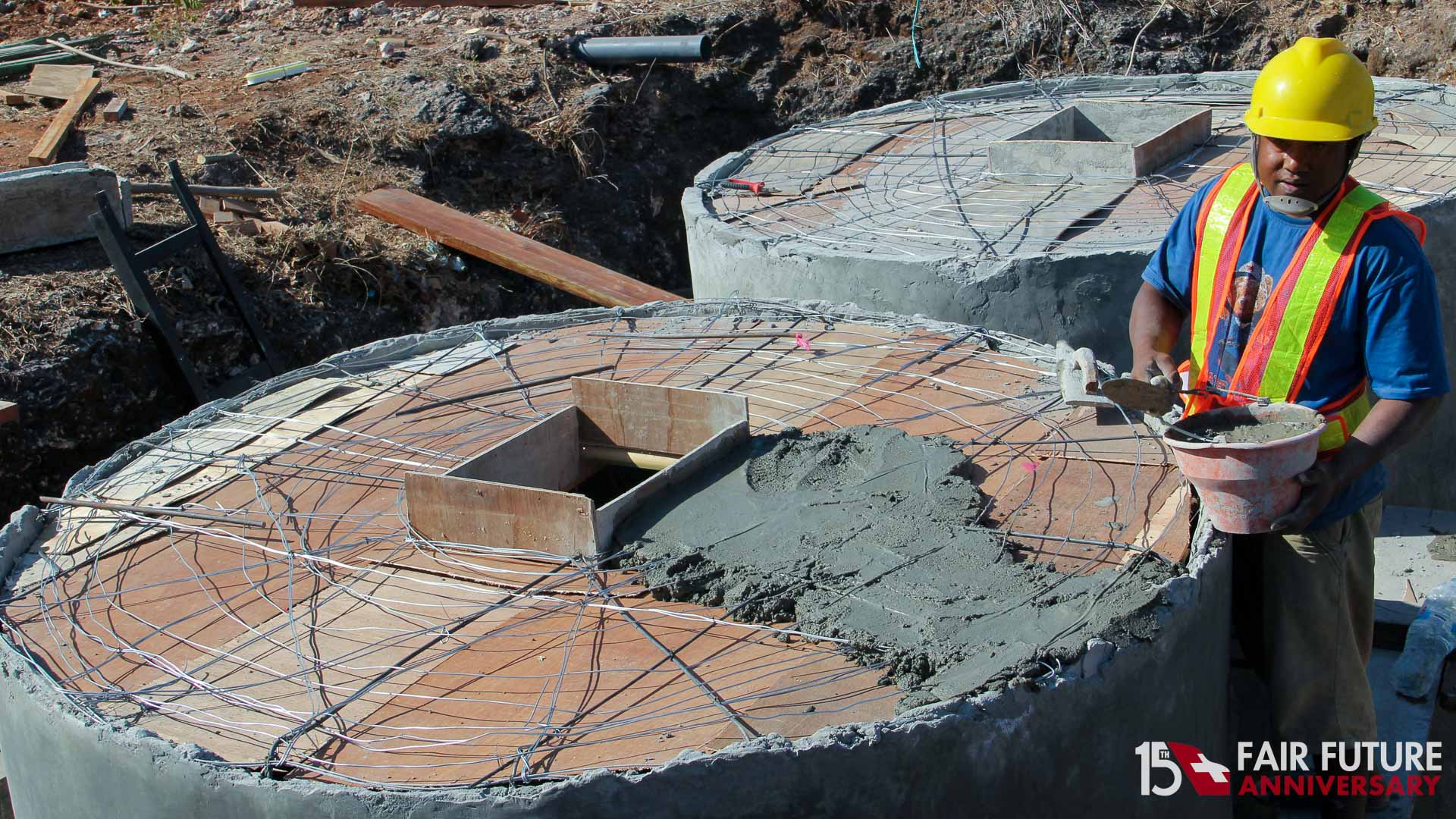
This New “Bild des Tages” shows the construction of ferrocement tanks in exceptionally remote locations. It shows two huge tanks under construction, each with a massive 10,000-litre capacity, twice the size of our usual tanks.
In areas where access to Sauberes Wasser is non-existent, our teams on the ground are building tanks using so-called ‘ferrocement’ technology. These tanks have been designed to store Regenwasser collected from local rooftops, once these rooftops have been checked and determined to be ‘fit for collection’. Our specially developed filtration systems ensure that before entering these 10,000 litre ferrocement containers, all collected Regenwasser undergoes a thorough cleaning process to ensure that the resulting stored water remains safe and clean.
Die ferrocement Bauarbeiten process involves layering wire mesh with cement und sand mortar to create strong and durable structures of a thin nature. Due to its exceptional Resilienz and insensitivity to damage from external forces, this material is highly recommended for us to construct Wasserbehälter located in remote locations where resources are scarce und Nachhaltige Lösungen are a priority.
These tanks offer a considerable advantage due to their hygienic structure that prevents the infiltration of air, light, heat or any form of impurities, including dirt and animal waste. Equipped with specially designed lids, these tanks are sealed against contaminants, thus ensuring clean and safe water storage.
The construction of these tanks is both cost-effective and relatively easy. A 10,000 litre ferrocement tank, as shown in the photo, would require approximately 1.000 Schweizer Franken to construct. Therefore, creating a Reservoir that can hold up to 20,000 litres – enough for many families in a village or region to access Clean Water – would cost around 2,000 Swiss francs. Ost-Sumba has no traditional means of obtaining clean drinking water; Regenwasser must, therefore, be used if survival is at a premium here.
The impact of these sanitised Wasserreservoirs on extremely remote households is considerable. The availability of pure drinking water significantly reduces Infektionskrankheiten wie zum Beispiel Polio, Malaria und Dyskinesie. Better cleanliness und Hygiene-Praktiken translate into better health conditions that reduce the burden of Krankheit, helping families to focus more on improving food intake und Lebensbedingungen. In a region where construction resources are scarce and facilities insufficient – their existence provides more than a solution – it represents a perspective in terms of water accessibility for the economies of these Ultramaritime Regionen and villages in the future.
Fair Future Stiftung medico-social camp in East Sumba – Rumah Kambera, Lambanapu – The 26th of Auguts 2024.