Cette image se trouve dans 1920×1080 Résolution. Cliquez dessus pour l’agrandir et l’afficher à pleine taille.
Hambarita water reservoir plaques and eight new family-named ferrocement tanks
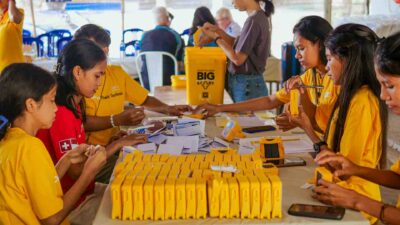
Cette nouvelle Photo de la journée captures the moment just before the installation of eight new reservoirs in Hambarita. Le plaques, patiently placed on the dry grass, will soon be affixed to the ferrocement walls that the community has carefully smoothed. Each plaque proudly bears a name chosen in the local language, reflecting the cultural belief that water is more than just a resource; it is a cherished member of the family to be welcomed, protected, and celebrated with the arrival of the rains.
Simple yet meaningful names—Wai Ma Hammu, Wai Kahingir, Wai Ma Njanjar, Wai La Wurung, Wai Maringu, Wai Pandulang, Wai Pa Luri Wangu, and Wai La Padang—were thoughtfully selected by children and approved by elders. These names, applied to reservoirs, ensure their purpose endures beyond the current season. Naming is not merely decorative; it is vital, as it fosters a sense of responsibility. When reservoirs are named, community members become engaged: they identify repairs, clean gutters, replace covers, and clear water inlets. This routine encourages ownership, which benefits community health.
Each reservoir holds between 4.4 and 5.3 cubic metres of rainwater, a crucial resource for drinking, cuisine, washing hands, and baignade during the dry season, when the land is parched and roads may be impassable. This results in fewer cases of diarrhoea and Infections de la peau, provides essential hydration for feverish children, and relieves mothers from the strenuous journeys to distant water sources. For families, especially young girls, accès à l’eau potable ushers in a new era of health, savings, and valuable time.
This project is a collective achievement. Families contributed by working on the tracks, mixing materials, and lifting lids. Our teams, supported by Un avenir juste et Kawan Baik Indonesia, ensured standards were met, from material proportions to structural strength. Unlike traditional methods, these réservoirs require no electricity, relying solely on the natural energy de rooftops et le sky. When the rains arrive, each reservoir will quietly fill (less than 2 hours with a big rain), signalling a subtle but significant change.
Looking back at this photograph, see these plaques not just as labels, but as heartfelt promises. Soon, they will be securely fixed, and Hambarita will welcome eight new members of the community, ready to transform lives.
- We invite you to read the final report of this project here by downloading this PDF document.
- Would you also like to participate in the construction of one of these reservoirs?
- Explorez la carte interactive du projet Laindatang Hambarita Pour voir l’emplacement exact de chaque réservoir et des ouvrages connexes.
- Visitez la galerie en ligne complète plus de soixante images liées à ces huit réservoirs ici.
- See the full gallery of nine information panels that detail the story, capacity, and impact of each reservoir, including the eight built in Hambarita.
Today, the 11th of November 2025 – Alex Wettstein
Autres lectures
- Organisation mondiale de la santé: Guidance on safe water and prevention of diarrhoeal diseases.
- UNICEF WASH: Community-led programmes for water, sanitation, and hygiene for children.
- Rotary International: Global network supporting community water projects.
- IRC WASH: Evidence and tools for sustaining rural water services.
- WaterAid: Rural rainwater harvesting and promoting hygiene behaviours.
- Engineers Without Borders Australia: Suitable technology for remote communities.
- Sphere Standards: Minimum standards for water supply and hygiene in emergencies.
- CDC Global Water, Sanitation, and Hygiene: Technical resources for reducing disease.