


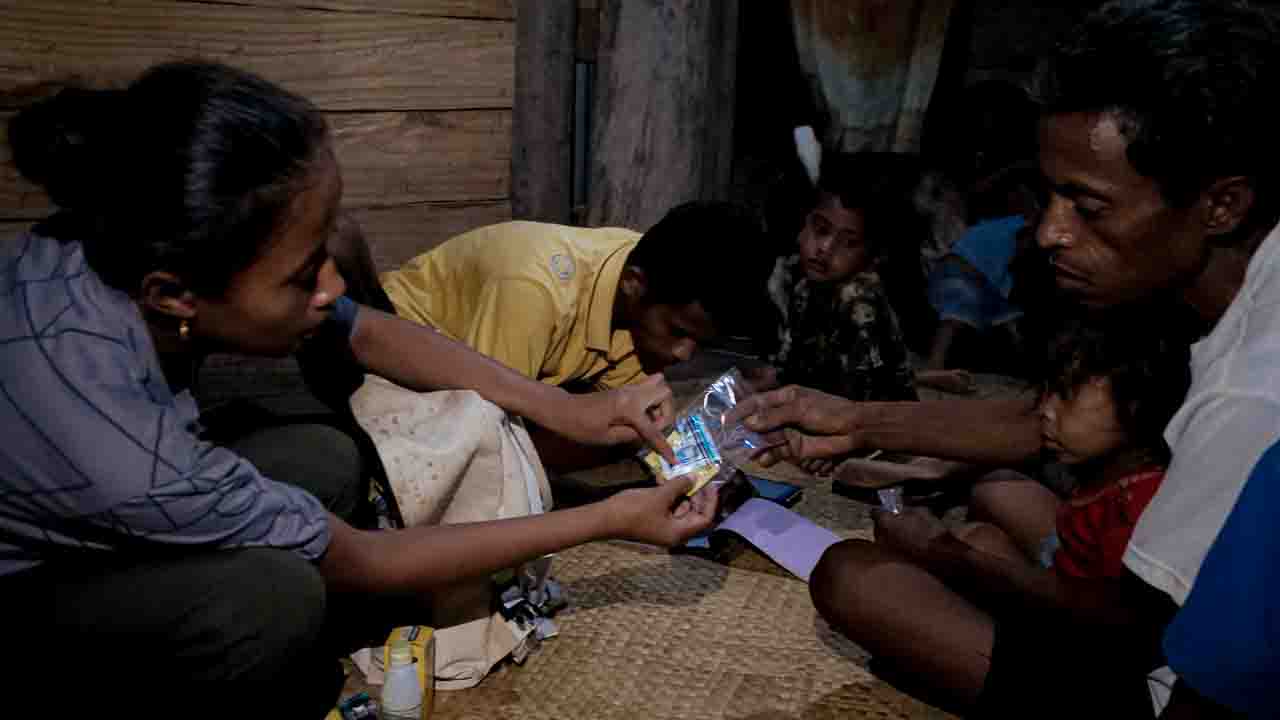
In their house in Lahiru, Sarlota and Yosef explain how to take the medicines to a father and his children.
One day in my life with Sarlot and Yosef, from Lahiru
In this film, we spend a day with Sarlota and her husband Yosef dans le village de Lahiru, in the Mahu district. They are both Kawan Sehat health agents with the Primary Medical Care program. Yosef smiles, saying he’s the only man among all these women. They laugh about it, but they take their work very seriously.
Sarlota is also a teacher for the Charis Foundation, which builds small learning centres in areas where there are no schools or where the schools are too far away. Yosef is a farmer. He grows rice, corn, and a few watermelons to feed his family, and when he can, he sells his produce.
From dawn, the day is busy. Sarlota cooks and does laundry. Yosef cleans and repairs the house. Together, they walk down a steep and challenging path to the river to fetch water for cuisine, drinking, et washing. The round trip is over a kilometre. They often slip on the path, and the jerrycans and wet clothes are heavy, but this is their daily life.
Back home, Sarlota bathes her baby in warm water, which has been boiled and infused with local herbs to protect its health. Yosef goes to the garden to tend the crops. Then, they prepare their home for the next stage of their lives.
Every day, dozens of people come to their homes for treatment. Thanks to the support of the Fair Future Foundation et Kawan Baik Indonesia, Sarlota et Yosef examine people with fevers, clean wounds, dispense medicine, and explain how to prevent illness.
For them, caring for their neighbours is like caring for their own family. This film gives them a voice. It shows what Primary Medical Care is really like in a remote village.
Today, the 18th of November 2025 – Alex Wettstein
In Short – A clinic inside a family home
In Lahiru, patients cross steep paths and arrive at a front door, not a hospital gate. The waiting room is a veranda, the pharmacy is a wooden shelf and the exam table is a simple mat on the floor. Yet wounds heal, fevers fall and families learn how to protect their children, all inside one small house.
Sarlota and Yosef - Lahiru’s Only Healthcare Agents
2 224 SolarBuddy lampes ont été installées de Surabaya à Sumba afin d’assurer la sécurité électrique et l’éducation dans 24 villages.
Une mission humanitaire de l’Australie Rumah Kambera transforme la logistique en un impact sanitaire durable.
Après des mois de préparation et de coordination, 2 224 SolarBuddy lampes avoir atteint leur destination dans l’Est de Sumbawa. De la ville de Surabaya au nouveau site de stockage La maison de Kambera, Cette opération marque un tournant dans La logistique de Fair Future et des capacités de communication. Ces dispositifs ne sont pas des simples boîtes de lumière, mais des instruments prévention, éducation, et la communauté résilience.
Libéré de taxes grâce à une exemption humanitaire historiquen, les lampes sont arrivées en Indonésie grâce au soutien inébranlable de SolarBuddy Australie et Rotary International. Une fois à Denpasar, notre équipe a minutieusement documenté, réemballé et rangé chaque lampe afin de la transporter en toute sécurité par voie terrestre et maritime. Les volontaires ont soigneusement chargé chaque boîte dans un conteneur de transport. Truck n’Load et des véhicules partenaires pour le voyage vers l'est.
Dans La maison de Kambera, un Un stockage dédié Une installation était prête Recevoir le colis. Les boîtes jaunes éclatantes, disposées soignélement, remplissent désormais le nouveau bâtiment de la fondation. magasin, Prêt pour déploiement 26 villages ultra ruraux et des dizaines d'écoles hors réseau. SolarBuddy Appli Tracker, développé à l'interne, s'assurera que chaque lampe soit enregistrée, traçable et liée à son destinataire.
Ces lampes sont bien plus que des appareils alimentés par l'énergie solaire.. Ils réduisent Risques de brûlures et problèmes respiratoires de kerosine, Les lampes de poche permettent aux enfants d’étudier en toute sécurité la nuit, et permettent aux familles de cuisiner et de se promener sans crainte dans l’obscurité. Les lampes de poche deviennent un outil de prévention des blessures et d’équité éducative dans les zones où l’accès aux soins de santé est limité.
Chaque étape—du dédouanement jusqu’à la coordination locale—une précision requise, une documentation minutieuse et une dévouement inlassable. Derrière chaque lampe se trouvent des noms, des mains et des kilomètres parcourus. Cette distribution Il s’inscrit dans une démarche à long terme visant à améliorer les conditions de vie grâce à des solutions durables et fondées sur la participation des communautés.
Les lampes Ils sont là. La mission se poursuit. Ce qui arrive aujourd'hui est lumière, dignité, Protection, et l’avenir opportunité.
Nous vous invitons cordialement à tous captivé par là histoire découvrir notre Galerie photo, témoignez de cela Effort extraordinaire, et nous engageons davantage à collaborer avec nos mission par notre intermédiaire Compte Instagram.
Alex Wettstein – Un avenir juste Fondation Camp médico-social Dans l’Est de Sumbawa – La maison de Kambera, Lambanapu – 13 juin 2025
Liens connexes


Liste des organisations liées avec des liens hypertexte
- Organisation mondiale de la santé (OMS): Serves as the global technical reference for primary healthcare, infectious disease control and community health strategies in low-resource settings.
- UNICEF: Concentrates on child health, nutrition, vaccination, and education, particularly where public systems are weak or absent.
- UNFPA: Focuses on maternal health, reproductive health services, and the protection of women and girls in vulnerable communities.
- Partners In Health: Provides long-term community-based medical care, training local health workers in remote and impoverished regions.
- Médecins Sans Frontières (MSF): Offers emergency medical care and supports hospitals and clinics in crisis and low-resource contexts.
- Women Deliver: Champions gender equality, women’s health, and rights, with a strong emphasis on access to quality care and local empowerment.
