In Umalulu, 300 malaria surveys across 400 homes help us map infections and protect 1,400 villagers
With Rotary’s support, we distributed 300 nets, collected vital data, and empowered local health heroes
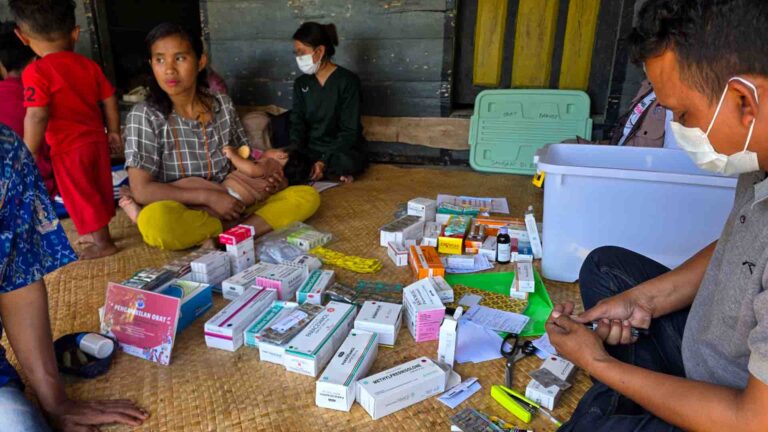
Dans Umalulu, un remote subdistrict of East Sumba, the Kawan Against Malaria programme led one of its most ambitious health actions to date. Over ten days, seven dedicated volunteers—trained community health agents—visited nearly 300 homes, surveying more than 1,400 individuals to better understand how and why malaria continues to thrive in this region.
With support from Rotary International and local authorities, the team used the Kawan Against Malaria mobile app to conduct 300 structured surveys. Each data point was geotagged and recorded in real time—even in areas with weak connectivity—thanks to the app’s offline features. This level of precision allows Fair Future Foundation’s medical team to create dynamic risk maps and model the impact of targeted interventions. In fact, geospatial analysis is crucial in epidemiology, as Swiss experts have shown, offering insights that guide effective public health responses.
One of the most visible successes of this operation was the distribution of 330 long-lasting insecticidal nets (LLINs), certified under WHO MILDA standards. These nets were given to households with the highest vulnerability—children under five, pregnant women, and families living in areas with poor housing conditions or stagnant water sources. Each net represents more than protection; it represents survival. The implementation of LLINs aligns with global best practices and Swiss research, such as those from the Swiss Tropical and Public Health Institute, which highlight the effectiveness of integrated vector management in reducing malaria transmission.”
But this was not simply a campaign of distribution. It was about empowerment. Volunteers engaged in open conversations with families, explaining how malaria spreads and how to use the nets properly. They also identified key environmental risks around homes, such as uncovered water containers or inadequate sanitation, which may accelerate mosquito breeding. These educational efforts are backed by findings from the Fair Future Foundation et Kawan Baik Indonesia, underscoring the importance of community education in enhancing malaria prevention measures.
This action in Umalulu is not an end—it’s a critical data point in an evolving map of disease prevention. The final report, scheduled for release in July, will guide future prevention strategies not only in Umalulu but across all of East Sumba.
In regions where doctors and medical infrastructure are absent, this kind of community-led survey is the frontline of health equity. Thanks to technology, partnerships, and the courage of our Agents de Kawan Sehat, we are rewriting the story of malaria in places too often forgotten. As demonstrated by Swiss public health experts from institutions like Swiss TPH et le Swiss Data Science Center, geospatial analysis plays a vital role in understanding disease spread and guiding targeted, evidence-based interventions.
Nous vous invitons cordialement à tous captivé par là histoire découvrir notre Galerie photo, témoignez de cela Effort extraordinaire, et nous engageons davantage à collaborer avec nos mission par notre intermédiaire Compte Instagram.
Alex Wettstein – Un avenir juste Fondation Camp médico-social Dans l’Est de Sumbawa – La maison de Kambera, Lambanapu – August 4th, 2025
Liens connexes