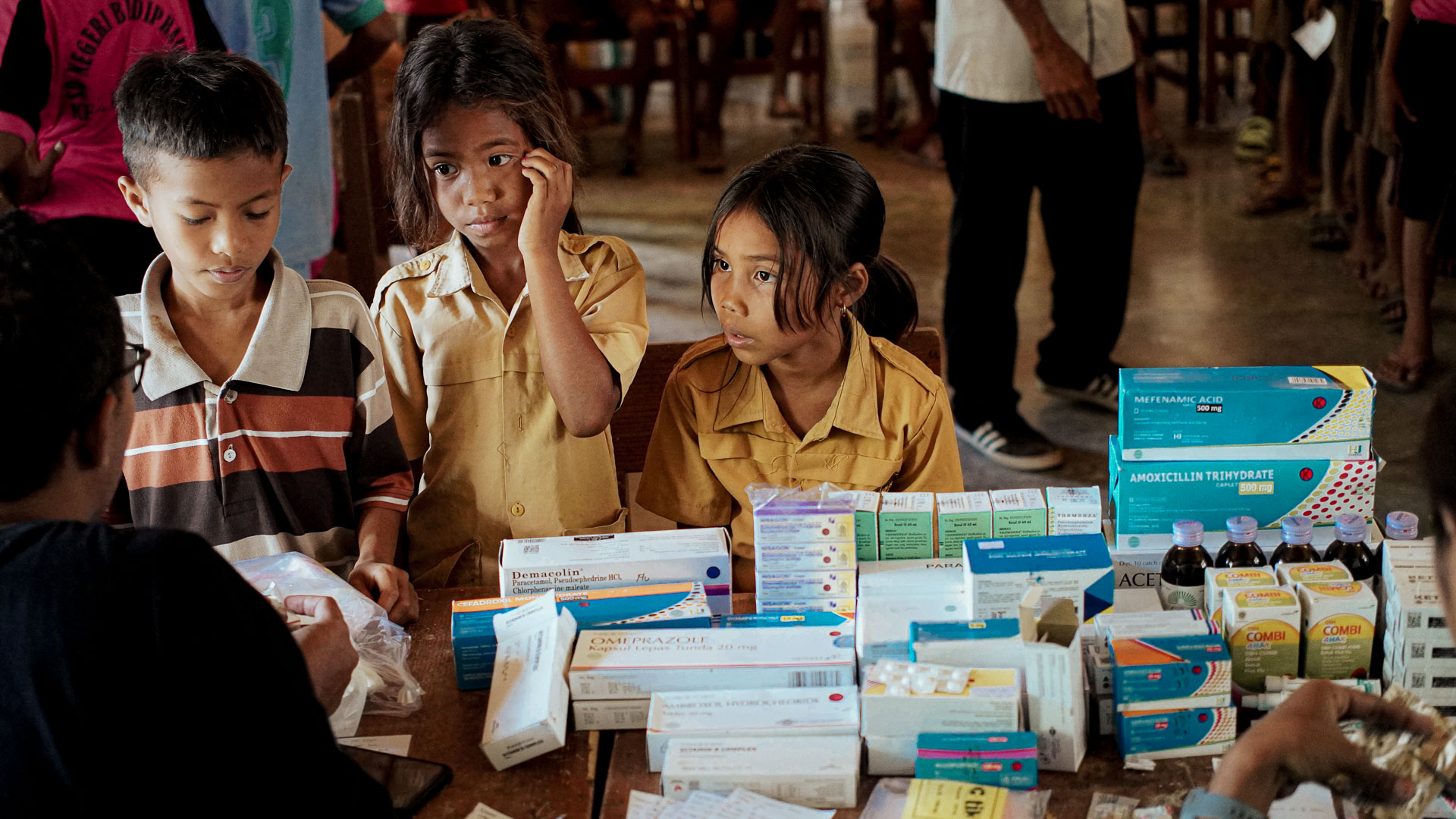
Children meet an adult across a table of medicines during a school community care day in southern East Sumba.
Photographie en format 1920 × 1080. Cliquez sur l’image pour la voir en plein écran.
Les soins communautaires dans l’est de Sumbawa dépendent d’un accès fiable aux médicaments
Cette nouvelle photo de la journée shows three children at a table covered with medicine boxes, bottles and blister packs. Our doctors are meeting patients at a school in southern East Sumba. During these community care days, access to medicines matters at every consultation, alongside assessment and clear explanations.
Access to medicines for rural communities
Our teams need reliable supplies, and local puskesmas also request medicines from our foundation. A consultation must lead to treatment that a family can obtain. Advice alone cannot replace a needed medicine. Access to medicines also requires appropriate selection, safe storage and regular restocking.
Read why unsafe self-medication can delay diagnosis and cause harm, and why access to medicines must go with clinical assessment and clear advice.
Taking time to assess each patient
We frequently encounter respiratory illness, diarrhoea, skin and eye infections, untreated infected wounds and malnutrition. A cough needs assessment rather than an automatic antibiotic prescription. Diarrhoea calls for attention to fluid loss, while an infected wound needs timely care. Severe illness requires referral.
Nutrition and water intake should also be part of that assessment. An unwell child may struggle to eat or drink enough. Care needs to consider hydration, feeding and the family’s access to safe water and nourishing food. Medicines have a role, but they cannot replace these daily essentials.
Making prevention possible at home
Avec Kawan Baik Indonesia, Fair Future Foundation combines community care with posters and practical education on water, hygiene and nutrition. Advice must be understandable and achievable with what families can obtain. A poster about handwashing has limited value without water and soap.
Votre soutien helps restock essential medicines and care supplies selected to meet our patients’ needs. It helps us connect medical advice with the means to act on it.
Autres lectures
- WHO · Essential medicines: WHO explains why essential medicines must be available, affordable and quality-assured, with selection and prescribing guided by clinical need.
- WHO · Pneumonia in children: WHO describes childhood pneumonia, its warning signs and prevention, and why timely assessment and appropriate treatment matter for recovery.
- WHO · Diarrhoeal disease: WHO links diarrhoea prevention to safe water and hygiene, and explains the role of oral rehydration, zinc and care for dehydration in children.
- WHO · Malnutrition: WHO distinguishes wasting, stunting and underweight, helping explain childhood undernutrition without treating these measures as interchangeable.
- WHO · Sepsis: WHO explains sepsis as a medical emergency and outlines how infection prevention, early recognition and prompt treatment help reduce its risks.