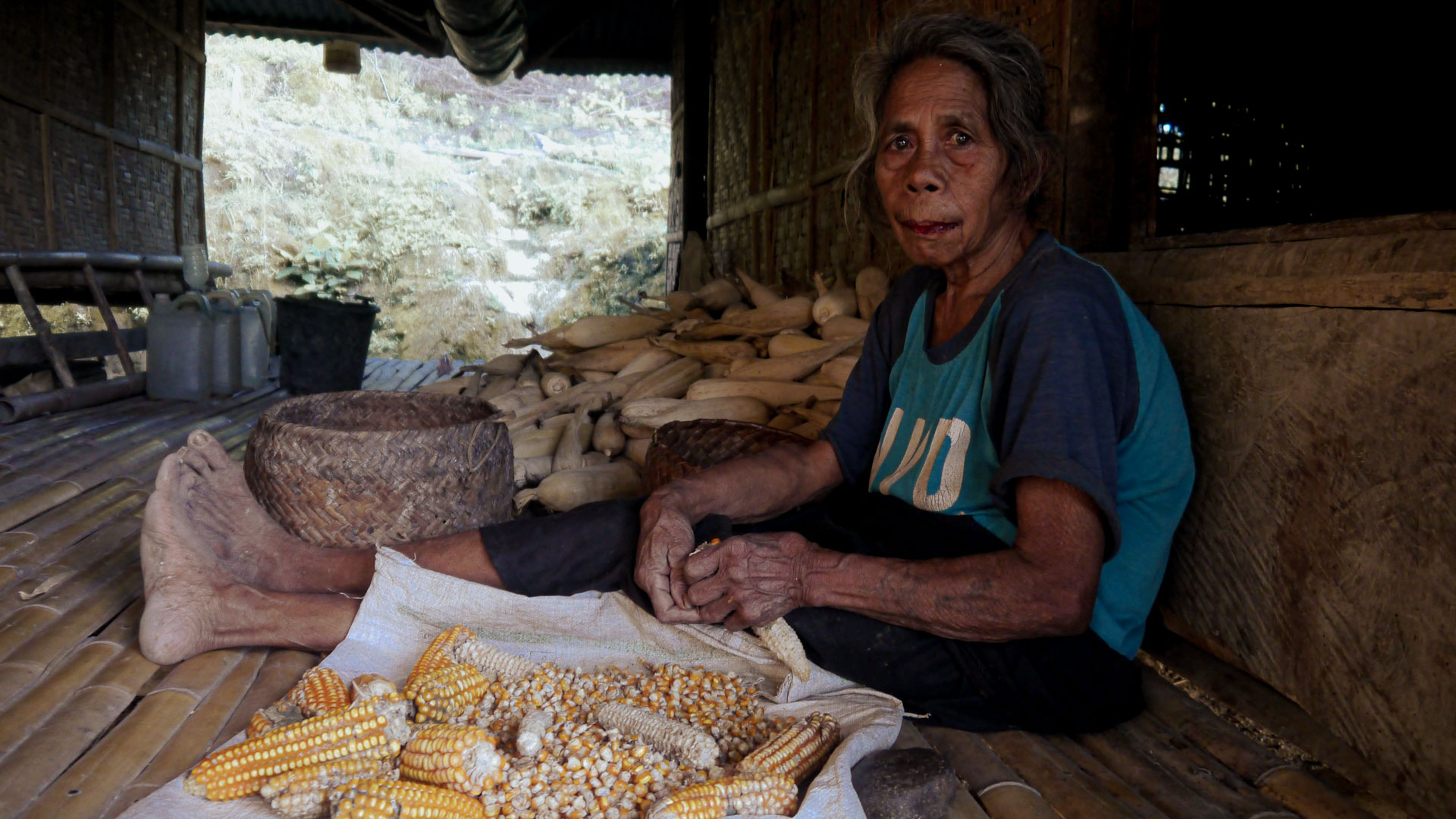
A woman shells maize inside her rural East Sumba home, with baskets and stored cobs beside her on the bamboo floor.
Photographie en format 1920 × 1080. Cliquez sur l’image pour la voir en plein écran.
Une femme qui cueille du maïs révèle la réalité quotidienne de l’insécurité alimentaire dans l’est de Sumba
Cette nouvelle photo de la journée shows a woman shelling maize in an ultra-rural East Sumba home. Her hands work above a sack of kernels, with baskets and stored cobs around her. Her direct gaze holds our attention. The reality of food insecurity in Sumba takes shape here through the daily work of securing a meal, where income and access to basic services are scarce.
Understanding food insecurity in Sumba
We took this photograph recently in a home without clean water, electricity or road access. In the communities we visit, maize is the staple. Families sometimes add rice when they can afford it. Vegetables and meat are much less frequent. What reaches the cooking pot depends on what they can grow, exchange or buy.
Families sell sirih pinang products to buy maize seed and, when a little money remains, rice. Sirih is betel pepper, whose elongated green inflorescences are chewed with pinang, or areca nut, and kapur, or slaked lime. These are customary chewing ingredients, not a substitute for nourishing food.
Eating better requires practical access
Maize provides energy. But meals dominated by one staple can leave nutritional needs unmet. Adding rice alone does not supply the diversity needed for adequate protein, vitamins and minerals. This photograph cannot tell us whether this woman has a deficiency. That requires an individual assessment.
Food insecurity in Sumba cannot be addressed through advice alone. With Kawan Baik Indonesia, Fair Future Foundation connects nutrition education with Primary Medical Care and work on Eau propre. We discuss achievable additions, such as beans, leafy vegetables or eggs when available, alongside safe food preparation. Recommendations must reflect what a household can actually obtain.
This woman’s face brings us back to why we work here. We listen to what makes daily life difficult and build practical responses with people. Thank you to everyone who sustains this work. Eating better requires knowledge, water, access and the means to put that knowledge into practice.
Autres lectures
- Organisation mondiale de la santé: WHO explains how diverse, adequate diets support health, informing nutrition education when households depend mainly on maize and rice.
- UNICEF: UNICEF works to prevent malnutrition through better diets and nutrition services, with particular attention to children and their mothers.
- Food and Agriculture Organization: FAO connects agriculture, food systems and nutrition to improve access to healthy diets, relevant where households rely on crops and markets.
- World Food Programme: WFP addresses malnutrition through nutritious food and nutrition programmes, linking dietary needs with the practical barriers to obtaining food.
- Centres de contrôle et de prévention des maladies: CDC explains safer food preparation and handling, supporting practical hygiene education alongside efforts to improve household nutrition.