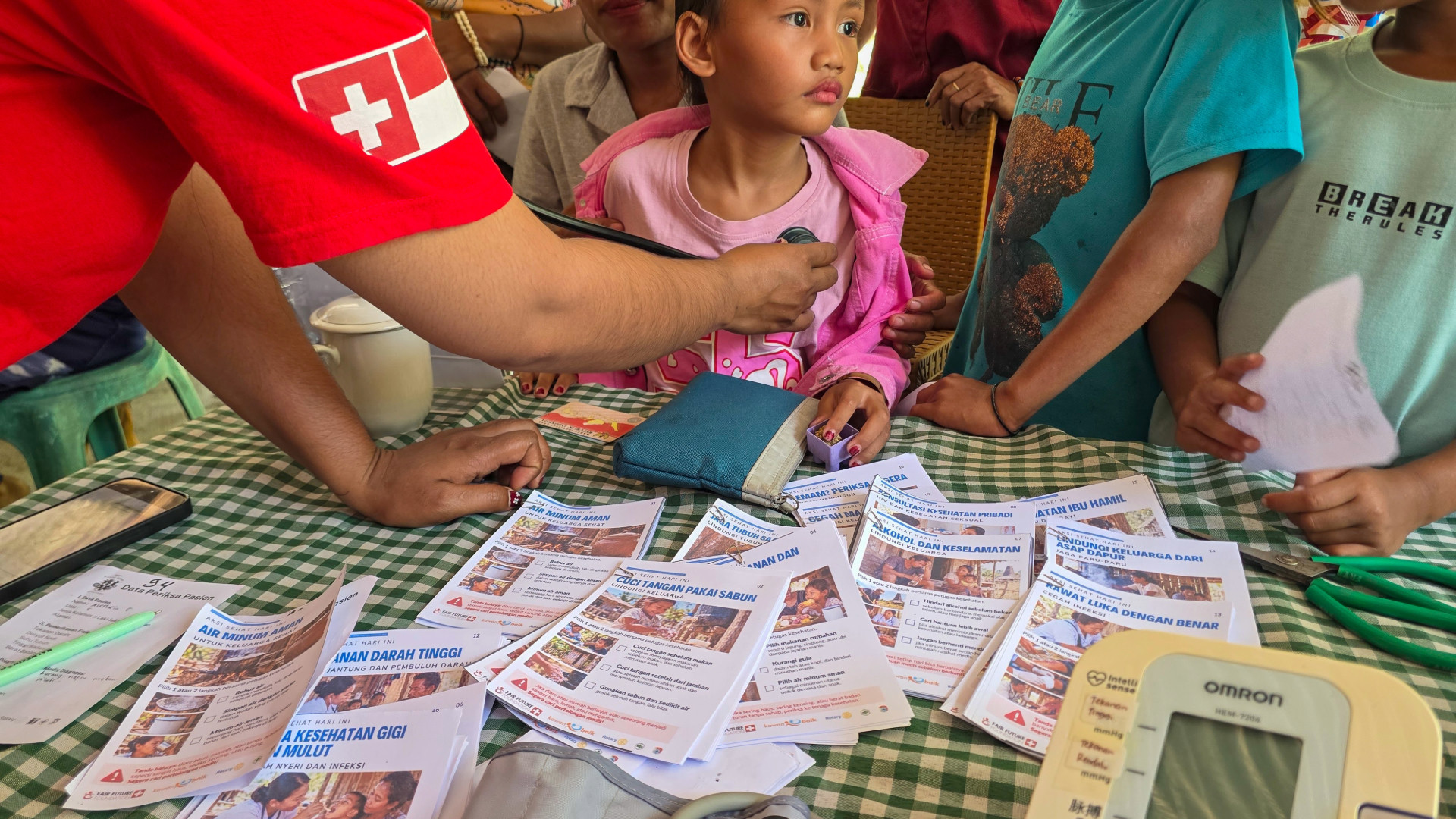
A doctor examines a child beside illustrated health cards during the 24 October community care day in Bidi Hunga.
Original photograph, 1920 × 1080 pixels, unchanged. Click the image to view it at full size.
Un stéthoscope, seize cartes et un soin à emporter à la maison
Cette nouvelle photo de la journée shows a child being examined in Bidi Hunga, with our illustrated health cards spread across the table. Swiss and Indonesian flags meet on the doctor’s sleeve. On 24 October, community health prescriptions joined the consultation, giving families practical steps to take home alongside the care they needed.
Three hours to reach a consultation
Three off-road vehicles, including Truck of Life, brought us from Rumah Kambera. Around one hundred patients of all ages attended. Erwin organised the day with Alex, Ino, Elthon, Susanti and Primus, alongside three doctors, two nurses, a pharmacist and a midwife. Our earlier funding report explains the IDR 18 million allocated to this work.
Community health prescriptions begin with a conversation
The 16 cards in Bahasa Indonesia invite each person to choose one or two actions with a health worker. Safe drinking water, handwashing with soap, less kitchen smoke and recognising danger signs become part of the consultation. We also introduced our local doctors to this way of prescribing practical daily care.
The original idea came from Flavie Wettstein, a nurse specialising in emergency care at CHUV in Lausanne. Here, her idea sits beside a stethoscope, within reach of the people it is meant to serve.
Knowledge for the days after
Medicines dispensed during an outreach day are a finite supply. Education can help prevent illness and avoid unnecessary medicines, while prescribed treatments and access to follow-up remain essential. The blood-pressure card explicitly says to continue prescribed medication.
Community health prescriptions give us another responsibility. Explain clearly, choose actions a family can manage, and say when further care is needed. The consultation ends; those instructions must still be useful at home.
25 October 2026 | Alex Wettstein
Autres lectures
- WHO | Primary health care: WHO explains how primary health care brings prevention, treatment and community participation closer to people throughout their daily lives.
- WHO | Self-care for health and well-being: WHO describes supported self-care as a complement to health services, with safe information and access to professional care when it is needed.
- OMS | Eau potable: WHO explains the health risks of unsafe drinking water and the importance of safe, sufficient supplies for hygiene and disease prevention.
- WHO | Hypertension: WHO describes blood-pressure management, including healthy daily habits, regular checks and prescribed medicines when clinically indicated.
- WHO | Health promotion: WHO explains health promotion and health literacy, including the conditions people need to understand information and act on it in daily life.