


For five years, families have been facing invasions of tens of millions of locusts.
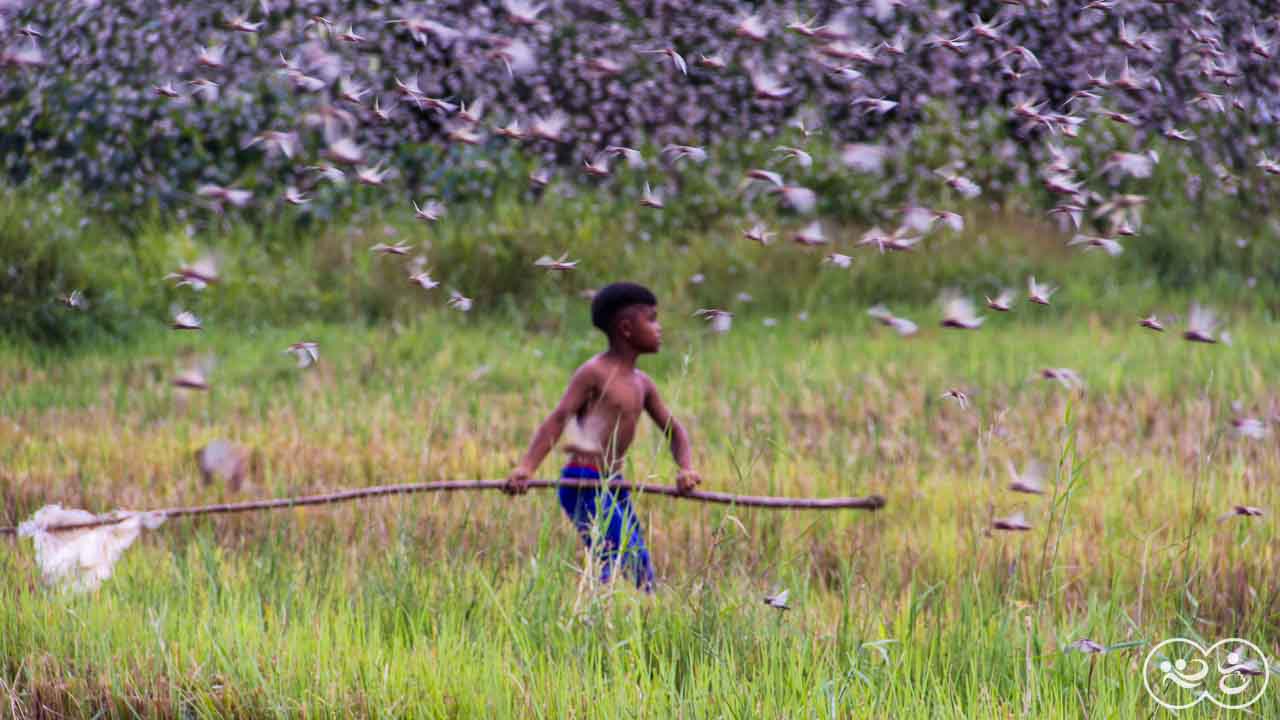
The situation is not just an agricultural crisis; it’s a profound human tragedy affecting the well-being and future of entire communities.
High populations devastate crops, trees, and gardens, leaving families starving and worsening issues like access to clean water and income.
The impact is enormous for these low-income families since their income is insufficient to buy other food, plants, or seedlings for replanting. Fear and stress drive people to meaningless actions, such as burning their entire fields to exterminate pests, but that also eradicates the area. On this subject, those who have come to this extreme tell us that: “-At least that allows us not to overthink about grasshoppers…”
But when pests destroy a field, the fear that it will start again grows stronger. And even if they had enough seedlings, they did not want to replant their fields because they were sure that everything would be destroyed before the harvest. Pest attacks occur on average twice a year and last for several months. May, June, July ++, and October, November ++. While we are still at the work sites in East Sumba, we can assure you that the pests are still there and that the phenomenon is not diminishing.
These swarms of pests destroy whole hectares of crops in a few minutes, mainly maize, the staple food of rural families in East Sumba. Really, in ten minutes, an entire one-hectare field of corn is reduced to nothing. Everything is eaten, right down to the ground.
In addition to the duration of the invasion, which can last for months, there are, of course, food losses for the populations. Poverty is very present here; the level of famine affects more than 80% of the population, and nearly 90% of children suffer from underweight and undernourishment. Sadness overwhelms these people because, as they told us: “-Enough is enough…”.
Help, too, is mainly anecdotal. All they get from the authorities is that the men spray gallons of pesticides. Every evening in the fields. And most of the time, without a mask, because they do not have one or have not received an adequate one. We met those who fell ill and had to go to the hospital from inhaling these toxic products. They suffer from hepatic and stomach pains, have nausea, skin problems, and burning eyes.

For over half a decade, East Sumba has faced a devastating pest infestation that has ravaged crops, left families in dire need of food, and triggered immense social and psychological hardship.
Pour more than eight years, East Sumba has been grappling with a severe pest infestation that has destroyed crops, left families in desperate need of food, and caused significant social and psychological distress.
The effects on economic stability, health, and food security are immense for these impoverished families, as their income falls short of covering the food shortages caused by pests. Vegetable crops—most notably maize—are crucial because rice remains prohibitively expensive. Consequently, they mix corn with small amounts of rice (when they can afford it) to add some bulk to their meals.
When the pest population surges, they wreak havoc on nearly all crops, trees, shrubs, and vegetable gardens. We are in touch with those most affected who share how their hard-earned fields and greens are utterly devastated within minutes. Grasshoppers consume crop leaves in mere seconds. As a result, no new growth is possible afterwards, permanently wiping out any harvests anticipated for the future.
To improve living conditions for families in ultra-rural areas, Fair Future Foundation and Kawan Baik Indonesia are seeking non-aggressive alternatives (other than pesticides) to combat pests that threaten East Sumba residents’ food security.
The conclusions are quite concerning. We are exploring strategies to address this issue and support families who are already facing economic challenges. We gather, analyse, and share data with our teams and decision-makers who can effect change.
Thank you for reading us. Today, 19 February 2025 – Alex Wettstein
Liste des organisations associées avec des liens hypertexte
- FAO – The Food and Agriculture Organization works to prevent pest outbreaks, improve food security, and support rural communities facing agricultural crises.
- IRRI – The International Rice Research Institute develops sustainable solutions to protect crops from pests, ensuring food security for vulnerable populations.
- CABI – CABI provides scientific expertise on pest management, helping farmers combat infestations that threaten livelihoods and food production.
- OMS – The World Health Organization addresses the health impacts of pest outbreaks, including the spread of vector-borne diseases like malaria and dengue.
- World Vision – World Vision supports rural communities affected by agricultural crises, providing emergency aid and sustainable solutions.
- USAID – USAID works to combat food insecurity and pest-related crises, ensuring affected communities receive critical resources and agricultural support.
- ICRAF – The World Agroforestry Centre promotes sustainable farming solutions to mitigate the impact of pest outbreaks and environmental challenges.
- CGIAR – CGIAR supports research and innovation to develop pest-resistant crops and protect vulnerable farmers from agricultural losses.
- IFAD – The International Fund for Agricultural Development helps smallholder farmers recover from pest-related crop failures and improve food security.

