Cette image se trouve dans 1920×1080 Résolution. Cliquez dessus pour l’agrandir et l’afficher à pleine taille.
Un homme âgé de Mbajik raconte son histoire à propos de l’arrivée de l’électricité
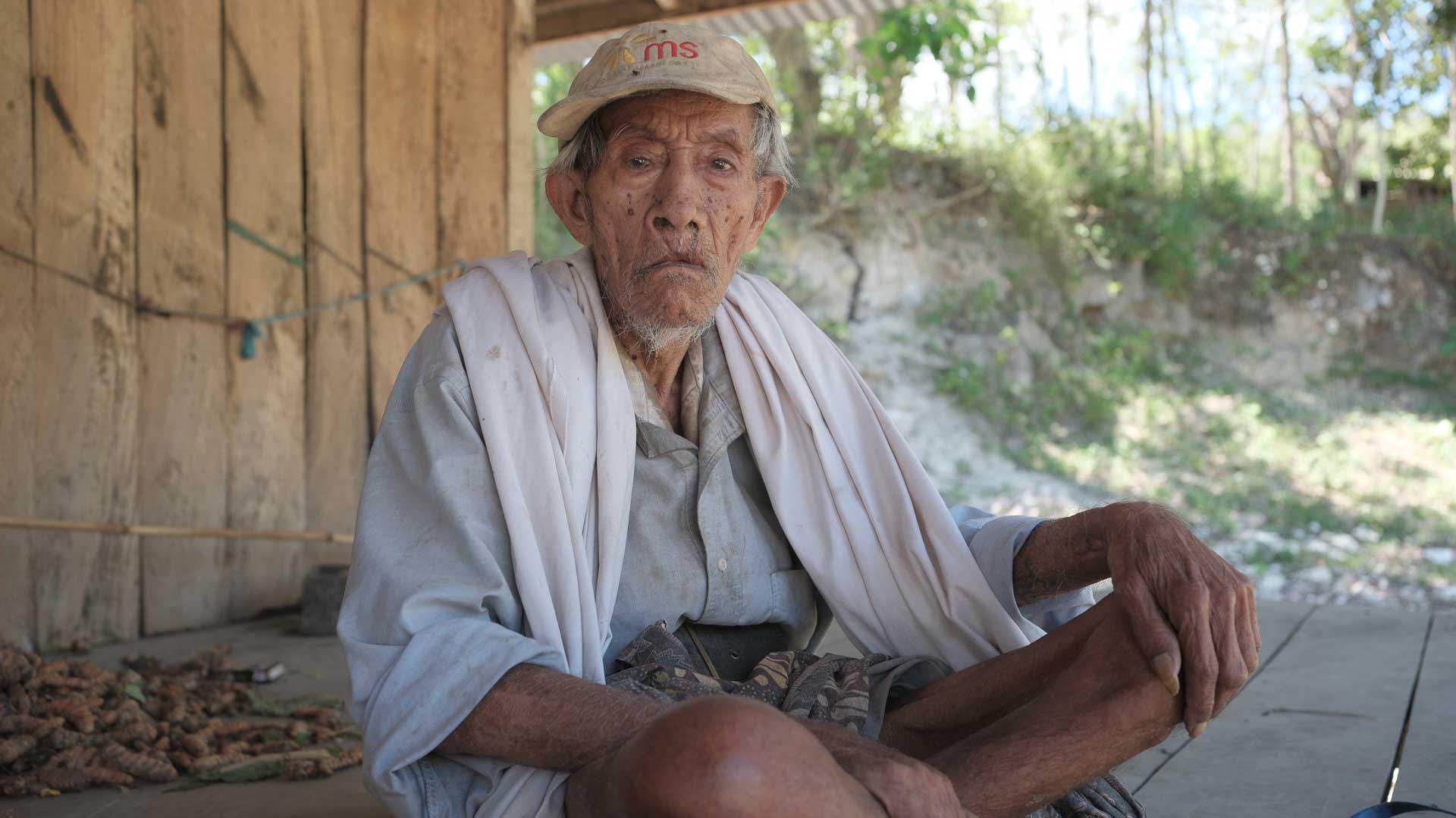
Cette nouvelle photo de la journée shows an older man sitting outside a house in Mbajik, East Sumba. Kalukur Namu Wali (his name) looks straight at the camera, one hand resting on his knee. His family told us he is 106. We have not verified his birth date. What we know from meeting him is simpler: he spoke clearly, shared his story and still walks every day. His portrait gives elderly care in East Sumba a human face.
Elderly Care in East Sumba Begins by Listening
I stopped because of his face and the way he looked at me. Then we stayed and listened. He told us about his life and made clear that daily life is difficult at his age. His ability to walk does not erase that difficulty. Both things can be true.
We do not often meet someone this old in the villages where we work. That observation is not a measure of life expectancy in Mbajik. It is one person, seated in front of us, with a long life that cannot be reduced to a number.
Care That Reaches People Where They Live
In a remote village, a journey for a consultation can be hard; even for a younger adult, for an older person, mobility, transport and the ability to return for follow-up all matter. Our Primary Medical Care programme, run by Fair Future Foundation and Kawan Baik Indonesia, works through locally trained Kawan Sehat agents and supervised field care. Listening, recognising a change and arranging assessment or referral when needed are part of care. This photograph does not document a consultation, and I make no claim about his health.
A Village Across Generations
We took this photograph in Mbajik, where our teams have also installed solar electricity for the school and brought electricity to the village. The children who learn there and this man who has lived through so much are part of the same place. Electricity changes what a school can do after daylight fades. A health system must also make room for the people who have grown old nearby.
Before leaving, I thought about how easily we speak of years lived, and how little that says about the ordinary effort of each day. I am grateful that Umbun Kalukur Namu Wali chose to speak with us. This is his portrait, not an illustration of old age in general.
24 September 2026 | Alex Wettstein
Autres lectures
- Organisation mondiale de la santé: Explains why older people differ widely in function and why health systems should support dignity, capacity and person-centred care.
- WHO Integrated Care for Older People: Offers practical pathways for primary and community care to identify changes in function, social needs and personal priorities.
- UNFPA Indonesia: Sets out the role of older people in Indonesian communities and the need for inclusive policies that protect health, dignity and participation.
- Indonesian Ministry of Health: Provides Indonesian public health information for older people and families, including prevention and attention to health in later life.
- HelpAge International: Describes community approaches to health and care in later life, including access, autonomy and support that reflects each person’s needs.