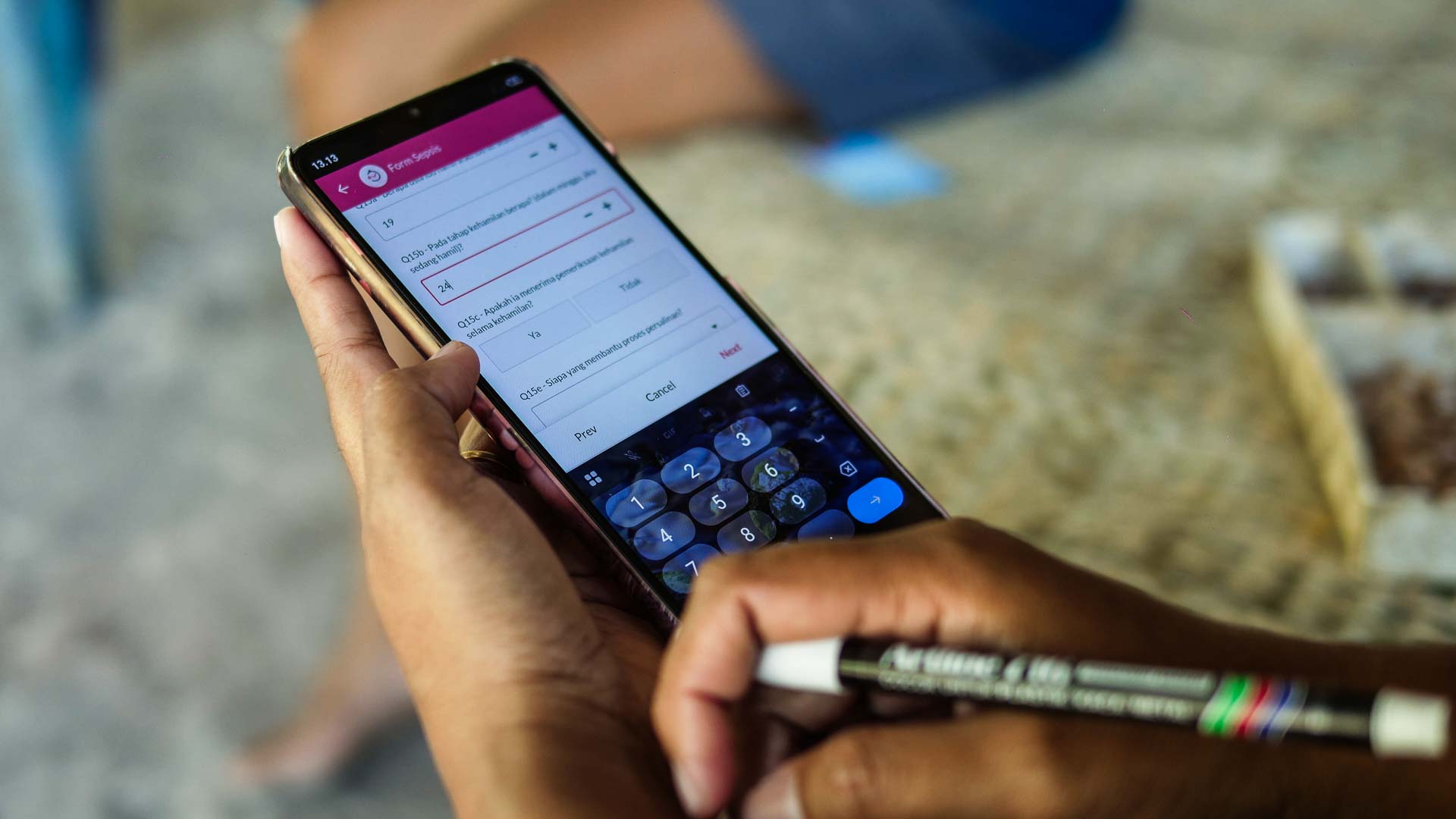
This image is in 1920×1080 resolution. Click on it to enlarge and view at full size.
From Over 1,000 Homes to Medical Insights in the East Sumba Sepsis Study
Today’s Photo of the Day depicts an enumerator utilising a mobile application developed for the East Sumba sepsis study during a household interview. This simple scene—comprising just a hand, phone, and structured questionnaire—is part of an intricate field study aimed at understanding severe infections, delays in care, and potential improvements before medical emergencies occur.
East Sumba Sepsis Study Update: The field phase is now complete. Our team of enumerators visited households, listened carefully, asked uniform questions using a structured format, and recorded responses directly into our specially developed study application. Over 1,000 households participated in the survey process. We sincerely appreciate the families who generously contributed their time and information to this effort. This extensive work has generated tens of thousands of lines of data currently under review and analysis.
The application did not eliminate the need for human interviews; instead, it ensured consistency and comparability across interviews. This is crucial in rural health research. Direct digital entry minimises transcription steps and enables later verification of any missing or inconsistent responses. However, the true value still lies with the individual who sits with a family, listens attentively, and accurately records their experiences.
From Field Data to Prevention: The East Sumba Sepsis Study Begins Its Analysis Phase. A practical goal drives the 2026 Sumba Sepsis Study. We aim to comprehend the progression from infection to severe illness, identify delays in seeking or accessing care, and determine conditions that may elevate risk. By turning household experiences into evidence, we aim to inform prevention strategies, promote early recognition and referral of sepsis cases, and strengthen future primary healthcare efforts.
Developing Medical Applications for People: At Fair Future Foundation and Kawan Baik Indonesia, we believe digital health is meaningful only when it directly benefits those in need. We create medical applications tailored to our teams’ needs and the work of Kawan Sehat agents who operate in remote areas lacking traditional healthcare infrastructure, ensuring information remains accessible at the point of care.
The phone in this photograph is not the main story on its own. The real story lies in the connection between a household, a skilled enumerator, structured data, and improved medical decision-making. Technology proves valuable when it brings us closer to people, enhances our understanding of their reality with greater precision, and enables action based on actual data insights.
Today, The 1st of September 2026 – Alex Wettstein
Further reading
- World Health Organisation – Sepsis: WHO defines sepsis, its clinical significance and global burden, providing the medical framework for prevention, recognition and research.
- World Health Organisation – Digital Health: WHO explains how digital health can strengthen equitable health systems when technology is designed around real needs and responsible use.
- World Health Organisation – Community Data Quality: WHO provides practical guidance for verifying community health data and reviewing completeness, consistency and system performance.
- World Health Organisation – Community Health Workers: WHO guidance supports effective community health worker programmes through training, integration, supervision and health system support.
- CDC – About Sepsis: CDC explains how infections can progress to sepsis, the warning signs that require urgent attention and the importance of rapid treatment.
- UNICEF – Digital Health and Information Systems: UNICEF shows how digital health and strong information systems can improve data quality, frontline decisions and access to primary care.
- PATH – Digital Innovation in Indonesia: PATH documents digital tools for community health workers in Indonesia, linking home visits, structured data and stronger primary healthcare.