


Donate
Support Care
Articles & News
Field stories
Glossary
Field guides

Community & Prevention Program
Community Empowerment
Communities are not the last link in our work. They are the people who decide, build, care, teach, document and keep each project alive.
- Built with communities
- 27 local health agents
- 10 bilingual health campaigns
Nothing lasts if people are left outside it
A water tank, a health service or a school becomes sustainable when local people help shape it, gain the skills to use it and have the means to maintain it. This is why community empowerment runs through every Fair Future programme.
The programme
Local knowledge, shared work and practical autonomy
We often say that Fair Future has a thousand collaborators. This is not a payroll figure. It describes the villagers, teachers, farmers, health agents, local leaders and families who work beside us and make projects possible.
When a reservoir is built, residents help choose the site, organise the work and build it with our teams. They learn a reproducible ferrocement method and how to inspect, clean and repair the system. When care is needed, people from the community are trained and equipped as Kawan Sehat health agents. In education, local adults learn how to teach and adapt practical knowledge to daily life.
Empowerment is therefore not a separate activity after delivery. It is the way each project is designed, implemented, documented and maintained. The aim is not dependence on Fair Future, but stronger local capacity with continued technical support and accountability.
Local women and men trained, equipped and supervised to provide safe first-line care and referral.
Visual prevention tools in English and Indonesian, built for teaching in homes, schools and villages.
Community participation turned lived experience into evidence for the 2026 Sumba Sepsis Study.
Ferrocement systems designed to be built with residents and maintained with locally transferable skills.
From presence to continuity
How participation becomes capacity
Community work is not a single consultation meeting. It is a sequence of shared decisions, practical learning, responsibility and follow-up that continues after the first visible result.
Listen in place
Families describe priorities, constraints, local knowledge and the risks that outsiders may not see.
Decide together
Communities and field teams agree on the need, location, roles, materials, timing and realistic limits.
Build and learn
Residents work beside technical teams, practising the method instead of receiving a finished object.
Use and teach
Health agents, teachers and local organisers pass practical knowledge from one household to another.
Maintain and improve
Local feedback, records, repairs and field follow-up show what works and what must be corrected.
Shared ownership, clear duties
Participation does not mean transferring risk
Communities bring knowledge, labour, leadership and continuity. Fair Future remains responsible for the technical, clinical, financial and safeguarding standards that make participation safe and meaningful.
What communities lead
- Describe priorities, barriers and locally workable solutions
- Help select sites and organise collective work
- Learn construction, maintenance, teaching and care practices
- Share prevention messages in familiar language and settings
- Identify changes, failures and emerging needs early
- Carry knowledge between households and across generations
What Fair Future must guarantee
- Financing, procurement and transparent use of resources
- Engineering standards, clinical protocols and safe limits
- Training quality, supervision and essential supplies
- Referral pathways when local capacity is not enough
- Documentation, monitoring and honest reporting of setbacks
- Long-term technical presence without replacing public services
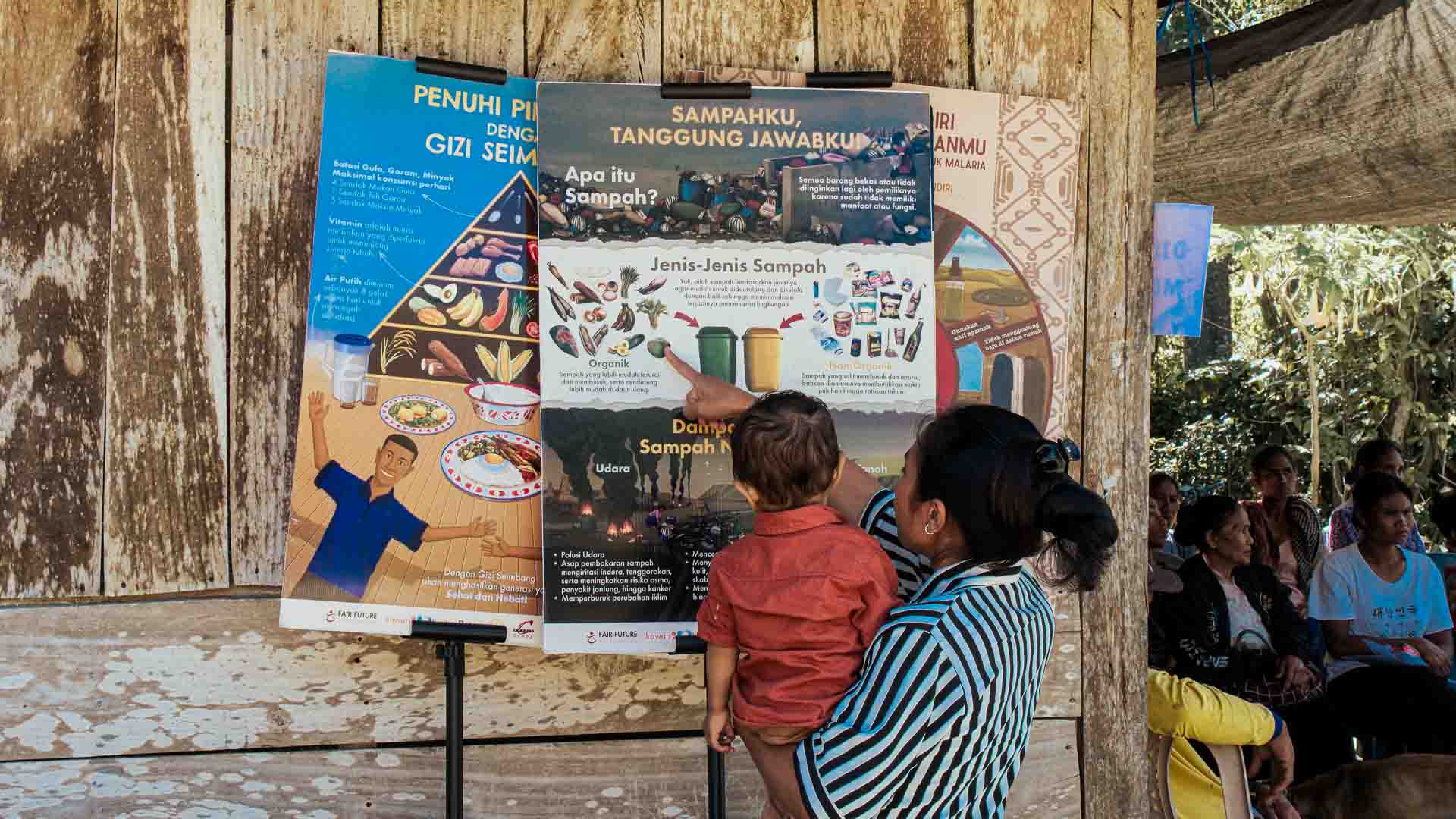
A workshop matters when people can take the message home, explain it again and connect it to decisions in daily life.
Knowledge that can travel
Ten campaigns made for community teaching
Fair Future has produced ten bilingual visual campaigns on hygiene, malaria, nutrition, tobacco smoke, waste, alcohol and HIV. The posters are designed for homes, schools, care days and village discussions. They turn technical guidance into images and language that people can use, question and teach to others.
10 visual campaigns
English and Indonesian posters for repeated, practical prevention work.
150-page health manual
Fourteen structured modules help local health agents learn safe first-line practice.
Offline field apps
Records, follow-up and evidence remain usable where connectivity is unreliable.
Reproducible methods
Construction and maintenance skills are taught through hands-on work with local materials.
What changes in practice
Capacity remains after the activity ends
Infrastructure can be maintained
Residents understand how a tank, water line, building or solar system was made and what routine care it needs.
Care begins inside the community
Trained Kawan Sehat agents recognise danger, provide safe first-line support and organise referral earlier.
Knowledge moves between households
Teachers, parents, agents and young people reuse books, posters and demonstrations in everyday settings.
Evidence reflects lived reality
Household interviews, field records and community feedback help programmes respond to actual barriers rather than assumptions.
Community healthMeet the Kawan Sehat agentsLearn how local women and men become trained first points of care, prevention and referral.
Water & infrastructureWater ConnectionsFollow reservoirs and distribution systems built with communities for local use and maintenance.
10 campaignsCommunity education postersOpen ten bilingual prevention campaigns covering health, hygiene, nutrition and daily risks.
Community evidenceSumba Sepsis Study 2026Explore results built from interviews with 1,001 households and 162 healthcare-worker submissions.
Live field recordField Notes from East SumbaRead short, dated updates on construction, training, prevention, research and local decisions.
Books & field guidesPractical publications to reuseBrowse books, manuals and illustrated guides made for teachers, health agents, children and families.
External referenceWHO community engagement guideRead the international framework for relationships that enable stakeholders to work together for health and well-being.
Live from the field
Community capacity, as it grows
Two recent signals from construction, water, care and prevention in East Sumba. These notes refresh automatically when a relevant Field Note is published.
Directly from the field
Latest Community Empowerment reports
These reports show empowerment in practice: villagers shaping projects, local people learning new roles, infrastructure built together, and knowledge moving through communities.

Discovering Local Food Resources for Healthier Lives
Fair Future actively supports ultra-rural communities with limited access to a diverse diet by raising awareness about local food resources. Our nutritionists teach families how to identify and prepare wild plants, fruits, and vegetables that are highly nutritious.

Empowering Health Workers: Saving Lives in Rural Areas
Kawan Sehat’s women health workers, through the Primary Medical Care program, are revolutionizing healthcare in extremely rural areas. Their unwavering commitment and specialized training allow them to save countless lives each day by providing essential medical attention for issues such as malaria, infections, and injuries.

Ferro Cement Water Reservoirs: A Lifeline for Communities
The Fair Future Foundation’s Water Connections program provides clean water to remote villages through manual construction of water reservoirs, reducing waterborne diseases and improving living conditions for women and children.

Tribute to Fair Future’s Lifeblood: Our Volunteers
Our foundation’s success in transforming lives in remote areas of Sumba is owed to our devoted volunteers at Fair Future Foundation. Over 100 individuals work tirelessly every day, constructing water tanks, delivering medical aid, and educating communities about healthy practices. Their unwavering commitment ensures life-changing impacts.

SolarBuddy lamps and letters connect two worlds
SolarBuddy lamps assembled by children overseas arrive with personal letters for children in rural Indonesia, connecting two communities through practical access to safe light.

Teaching kids how SolarBuddy lights can change their lives
Ayu demonstrates SolarBuddy lamps to children in rural East Sumba before distribution across off-grid villages, showing how safe light can support study and daily life after dark.

Join Us for Clean Water Awareness Event on June 14
Save the date! Join us on June 14, 2024, at Kulidan Space near Denpasar to celebrate Fair Future Foundation’s 15th anniversary. Our clean water awareness event includes the screening of ‘Matawai, the Shades of Water,’ discussions on sustainable water solutions, and artistic performances.

Lighting Up Lives: SolarBuddy Impact on Kids’ Homes
In remote regions where darkness limits access to education and safety, the SolarBuddy program provides a beacon of hope. These solar-powered lamps are not just sources of light; they are tools for learning and safety, significantly improving the lives of children by expanding educational opportunities and reducing nighttime risks.

Healthy Living with Clean Water and Nutrition
In East Sumba, the Fair Future Foundation is transforming lives through its Water Connections program, providing clean water, improving hygiene, and promoting nutritious meals and healthy lifestyles for a brighter and healthier future for all.

Let’s Wash Your Hands: A Lifeline for Rural Health
In East Sumba, washing hands is a lifesaving act. Fair Future Foundation’s ‘Let’s Wash Your Hands’ campaign, through Water Connections, has installed sinks in schools and villages, helping children fight diseases and grow healthily.

Four Pillars for a Healthier Life in Ultra-Rural Areas
Four Pillars for Healthy Living” serves as Fair Future’s guide for ultra-rural communities, emphasizing balanced lifestyle pillars: physical activity, nutrition, hygiene, and rest. This guide encourages daily exercise, a diet rich in fresh foods, regular washing with soap and water, and adequate rest for mental and physical health, aiming to…

Healthy Eating: Transform Lives with Nourishing Food
Fill Your Plate with Healthy Food” is an initiative by Fair Future Foundation aimed at enhancing health in ultra-rural areas. This educational poster, designed as a food pyramid, highlights the importance of balanced nutrition with locally sourced foods.
Accountability
Participation must leave skills, evidence and ownership
We document who decided, what was built or taught, how resources were used, what communities report and what still does not work. A participatory programme must be open to correction and show whether local capacity is genuinely stronger, not simply count meetings or completed objects.
