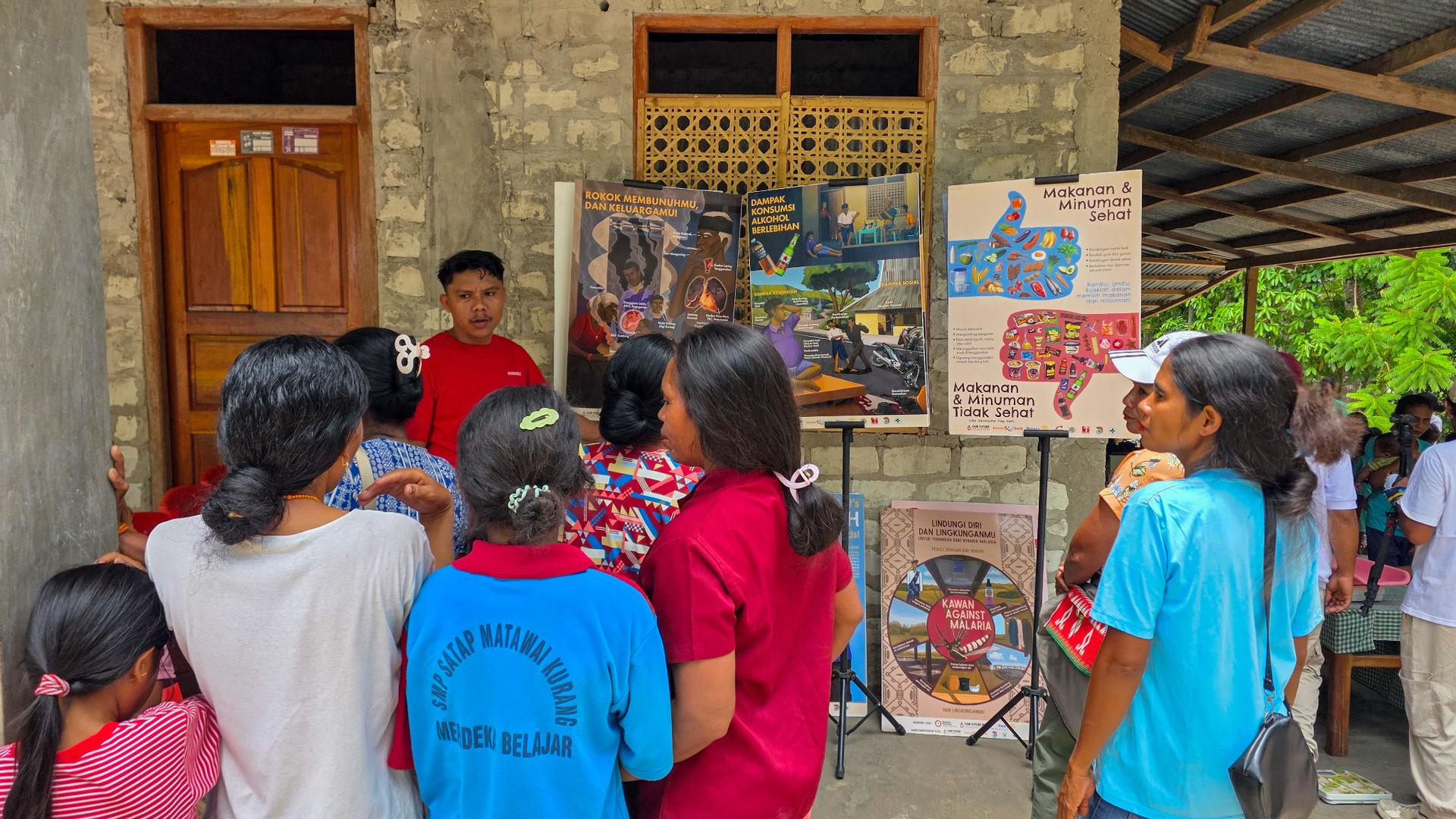
Erwin leads a health education workshop beside nutrition, tobacco and alcohol posters during the Bidi Hunga care day.
Authentic field photograph, resized to 1920 × 1080 pixels and compressed for the web. Full framing retained; no AI alteration. Click the image to view it at full size.
Where a Poster Becomes a Conversation
This new Photo of the Day shows Erwin facing a close group in Bidi Hunga, beside posters on tobacco, alcohol and food. Our Primary Medical Care field coordinator has brought the illustrations into a shared conversation. Here, community health education takes place within speaking distance, with room for people to ask their own questions.
Community health education needs time to listen
A child stands at the edge of the group. Adults gather near Erwin, while the posters remain visible above their shoulders. The photograph holds one moment from our 24 October community care day, when examination and treatment were accompanied by hours of education.
Our workshops use role-play, questions and discussion. People test explanations against daily life. For our team, listening to those questions matters as much as delivering the message.
Ten campaigns, drawn from life here
We created the drawings and graphics for ten educational poster campaigns ourselves. The healthy and unhealthy food poster uses recognisable foods; nearby images address smoking, second-hand smoke and alcohol. A malaria-prevention poster stands lower down. Other campaigns explain symptoms and everyday protection.
The clinical purpose is practical. Reduce harmful exposure, recognise illness earlier and know when to seek care. Advice about food must also respect what a household can afford and obtain.
Understanding belongs in the care plan
Community health education continues beyond the workshop through our guides and books, and the explanations in our field guides. A poster gives us something to discuss together; it cannot tell us what a person has understood.
We often say education is the best medicine. We mean giving people the knowledge to protect their health and seek help, alongside necessary treatment. The questions raised here are part of that work. They deserve time, clear answers and a place in our care.
26 October 2026 | Alex Wettstein
Further reading
- WHO | Health literacy: WHO explains how people access, understand and use health information, and why services must make explanations understandable and usable.
- WHO | Tobacco and nicotine: WHO describes tobacco harms and second-hand smoke exposure, with prevention measures that protect people who smoke and those around them.
- WHO | Healthy diet: WHO explains dietary balance, variety and food safety, while recognising that healthy diets depend on locally available foods and context.
- WHO | Malaria: WHO describes malaria prevention, common symptoms and warning signs, and explains why early testing and appropriate treatment are important.
- WHO | Alcohol: WHO explains the health and social harms associated with alcohol, including dependence, injuries and the need for accessible care and support.