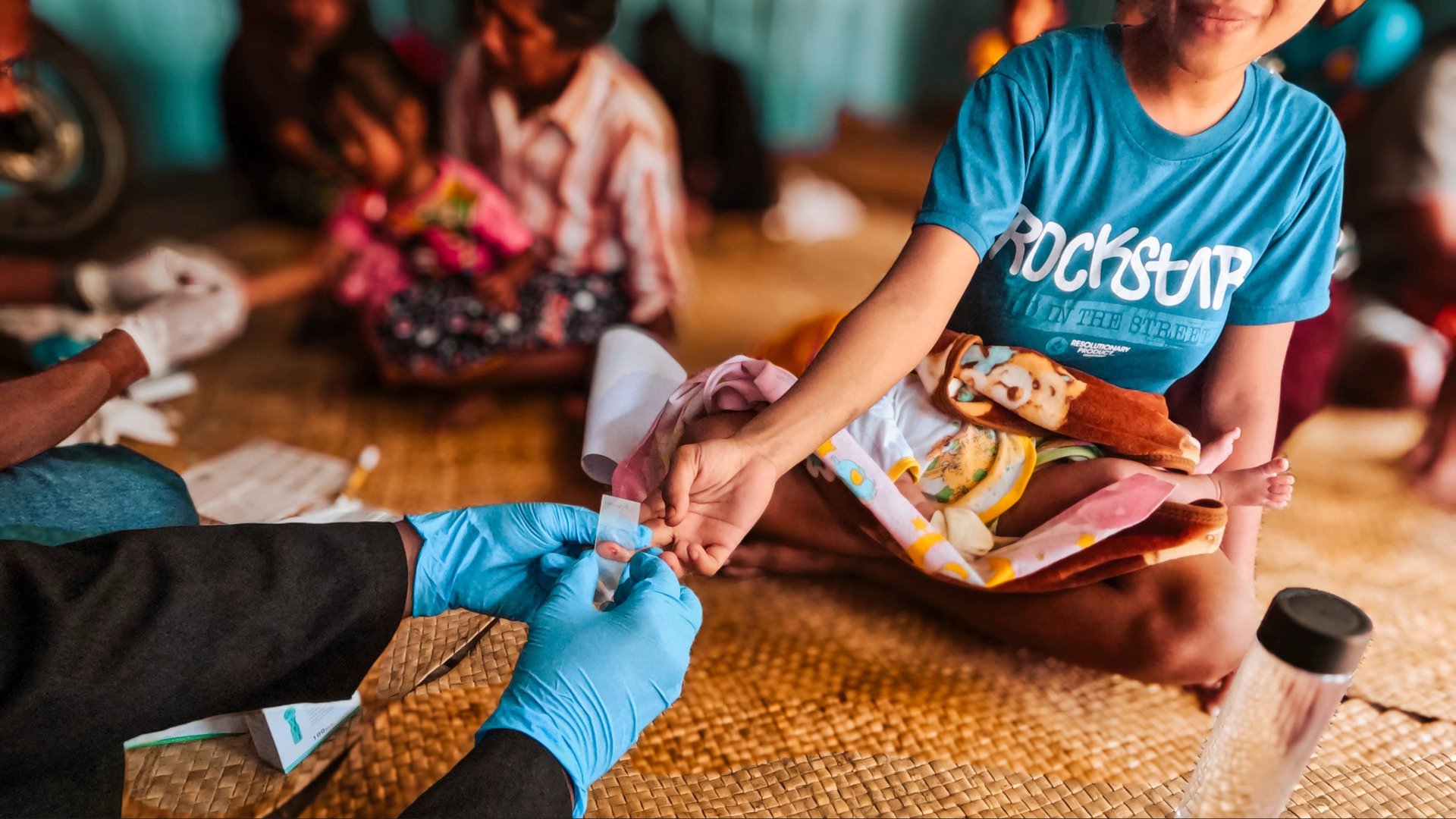
Blue-gloved hands support a mother’s finger beside a blood slide while her infant rests across her lap.
Authentic photograph taken by our field team in eastern Indonesia. Click the image to view it at full size.
A Small Blood Sample, a Moment of Care
This new Photo of the Day shows blue-gloved hands supporting a mother’s finger beside a glass slide bearing a drop of blood. Her infant rests across her lap. Taken by our field team in eastern Indonesia, this photograph brings malaria screening and prevention close to the person receiving care, one careful gesture at a time.
Malaria screening and prevention belong together
Through Kawan Against Malaria, our teams tested this mother and her child using rapid diagnostic tests and blood samples for microscopy. The photograph records the sampling gesture, not a test result. These methods help identify malaria and guide appropriate care. Testing does not prevent a mosquito bite, and the work continues beyond the sample.
Before the rains, and throughout the year
Malaria remains endemic in parts of eastern Indonesia, with cases throughout the year. As the rainy season approaches, water can collect in places where mosquitoes breed, while humid conditions help them survive. Transmission risk can rise. We continue malaria screening and prevention without waiting for the rains.
Knowledge carried into the home
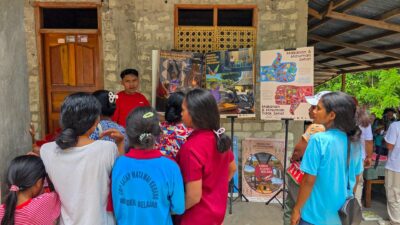
Our Kawan Sehat health workers carry two foundation posters, Recognising malaria and Preventing malaria. They support conversations about symptoms, insecticide-treated nets and reducing suitable breeding sites around homes. Fever, headache and chills call for prompt assessment; seizures or difficulty breathing require urgent care.
Our Umalulu malaria study helps us understand barriers to protection and care. A test must lead to an explanation and appropriate follow-up. Families also need practical ways to reduce bites, recognise illness and reach help.
27 October 2026 | Alex Wettstein
Further reading
- Fair Future | Recognising malaria: Our illustrated poster supports discussion of malaria symptoms and warning signs, helping health workers explain when prompt assessment is needed.
- Fair Future | Preventing malaria: Our prevention poster supports household conversations about mosquito protection and the environment, alongside guidance from trained health workers.
- Fair Future | Kawan Against Malaria: Our programme connects malaria testing, appropriate care and community prevention in eastern Indonesia, with practical education close to families.
- Fair Future | Umalulu study: Our 2025 Umalulu study explores household experience and barriers to prevention and care. Its historical reports are not current malaria prevalence.
- WHO | Malaria: WHO explains malaria symptoms, severe warning signs, testing by microscopy or rapid diagnostic tests, and ways to prevent mosquito-borne infection.