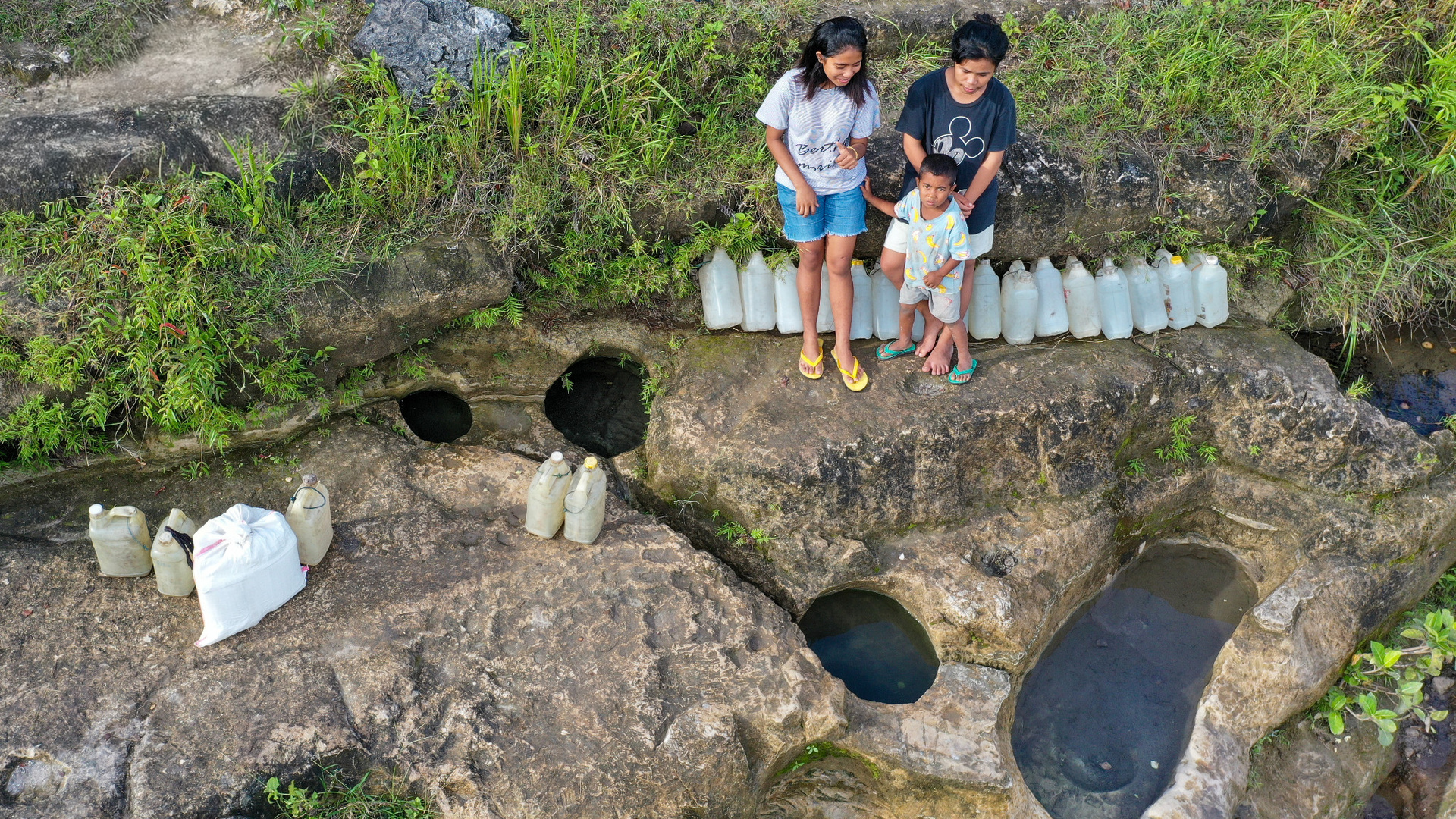
Jerrycans line a rocky ledge beside people collecting water from kullup cavities in rural East Sumba, Indonesia.
Photograph supplied by Alex Wettstein, Fair Future Foundation. Resized proportionally from 2048×1152 to 1920×1080 at his request, without cropping or altering scene content. Click the photograph to view it at full size.
Kullup in East Sumba, When Access to Water Determines the Conditions of Care
This new Photo of the Day shows people and jerrycans beside water-filled cavities in a rocky hillside. Known locally as kullup, these seasonal seepage points sustain households without a reliable water supply. They reveal how water scarcity in Sumba constrains hygiene, increases exposure to contamination and consumes hours of daily life.
Water scarcity in Sumba, beyond the volume collected
Rain infiltrates the ground upslope and emerges slowly into cavities often excavated by hand. Families take turns filling jerrycans; once a pool is emptied, the next household waits. Reaching them can take hours on foot. These sources recede and may dry out during the dry season.
In the situations we encounter, our field estimate is only 1.5–2 litres available per person per day. Drinking and cooking take priority, leaving little for handwashing, infant care or menstrual hygiene. Some families reuse water across tasks. These are constrained decisions, not a lack of concern for cleanliness.
Natural filtration does not establish microbiological quality
Clear water can contain microorganisms invisible to the eye. Passage through soil may reduce some contaminants but cannot establish the microbiological quality of a source. Human and livestock faeces can contaminate water where sanitation and source protection are inadequate.
We explain why clarity alone cannot identify clean water. Testing for E. coli helps detect faecal contamination and guide action. No laboratory result is available for this kullup; the photograph cannot establish contamination. Quantity, quality and reliability must be considered together.
Infrastructure, testing and practical prevention
With Kawan Baik Indonesia, Fair Future Foundation addresses water scarcity in Sumba through Water Connections, building reservoirs and sanitation facilities and undertaking drilling. Funding now limits this work, particularly drilling. The planned laboratory at the new Rumah Kambera centre will support water testing; it is not yet operational.
Better access means less time on difficult paths and enough clean water to maintain daily hygiene. It is a condition for protecting health, not an optional comfort.
Related Resources
Related field resources
- Fair Future | Water Connections: Our field programme connects reservoirs, rainwater collection, sanitation and community work to improve access to clean water in rural East Sumba.
- Fair Future | Rumah Kambera: The new socio-medical centre brings care, training, laboratory space and field logistics together in a project under construction in East Sumba.
- WHO | Water quality and health: WHO explains the health risks of faecal contamination and the importance of protecting water sources, reliable supply and effective water treatment.
- WHO | E. coli: WHO describes E. coli, routes of faecal contamination and prevention, helping distinguish a possible exposure from a confirmed finding in water.
- UNICEF | Menstrual hygiene: UNICEF explains how water, sanitation, appropriate materials and education support menstrual health, dignity and participation in everyday life.