


Donate
Support Care
Articles & News
Field stories
Glossary
Field guides

Community & Prevention Program
Community Empowerment
Communities are not the last link in our work. They are the people who decide, build, care, teach, document and keep each project alive.
- Built with communities
- 27 local health agents
- 10 bilingual health campaigns
Nothing lasts if people are left outside it
A water tank, a health service or a school becomes sustainable when local people help shape it, gain the skills to use it and have the means to maintain it. This is why community empowerment runs through every Fair Future programme.
The programme
Local knowledge, shared work and practical autonomy
We often say that Fair Future has a thousand collaborators. This is not a payroll figure. It describes the villagers, teachers, farmers, health agents, local leaders and families who work beside us and make projects possible.
When a reservoir is built, residents help choose the site, organise the work and build it with our teams. They learn a reproducible ferrocement method and how to inspect, clean and repair the system. When care is needed, people from the community are trained and equipped as Kawan Sehat health agents. In education, local adults learn how to teach and adapt practical knowledge to daily life.
Empowerment is therefore not a separate activity after delivery. It is the way each project is designed, implemented, documented and maintained. The aim is not dependence on Fair Future, but stronger local capacity with continued technical support and accountability.
Local women and men trained, equipped and supervised to provide safe first-line care and referral.
Visual prevention tools in English and Indonesian, built for teaching in homes, schools and villages.
Community participation turned lived experience into evidence for the 2026 Sumba Sepsis Study.
Ferrocement systems designed to be built with residents and maintained with locally transferable skills.
From presence to continuity
How participation becomes capacity
Community work is not a single consultation meeting. It is a sequence of shared decisions, practical learning, responsibility and follow-up that continues after the first visible result.
Listen in place
Families describe priorities, constraints, local knowledge and the risks that outsiders may not see.
Decide together
Communities and field teams agree on the need, location, roles, materials, timing and realistic limits.
Build and learn
Residents work beside technical teams, practising the method instead of receiving a finished object.
Use and teach
Health agents, teachers and local organisers pass practical knowledge from one household to another.
Maintain and improve
Local feedback, records, repairs and field follow-up show what works and what must be corrected.
Shared ownership, clear duties
Participation does not mean transferring risk
Communities bring knowledge, labour, leadership and continuity. Fair Future remains responsible for the technical, clinical, financial and safeguarding standards that make participation safe and meaningful.
What communities lead
- Describe priorities, barriers and locally workable solutions
- Help select sites and organise collective work
- Learn construction, maintenance, teaching and care practices
- Share prevention messages in familiar language and settings
- Identify changes, failures and emerging needs early
- Carry knowledge between households and across generations
What Fair Future must guarantee
- Financing, procurement and transparent use of resources
- Engineering standards, clinical protocols and safe limits
- Training quality, supervision and essential supplies
- Referral pathways when local capacity is not enough
- Documentation, monitoring and honest reporting of setbacks
- Long-term technical presence without replacing public services
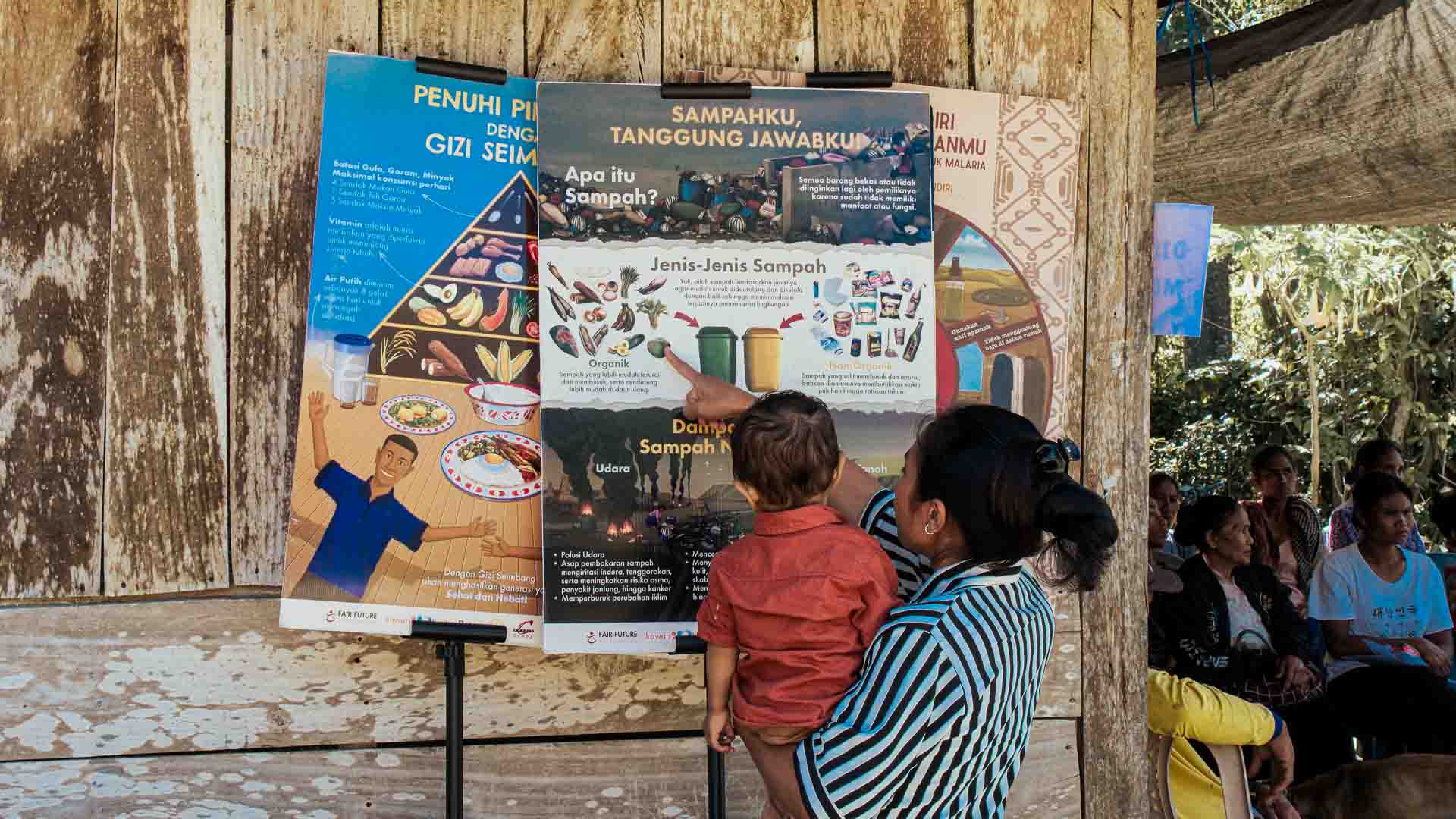
A workshop matters when people can take the message home, explain it again and connect it to decisions in daily life.
Knowledge that can travel
Ten campaigns made for community teaching
Fair Future has produced ten bilingual visual campaigns on hygiene, malaria, nutrition, tobacco smoke, waste, alcohol and HIV. The posters are designed for homes, schools, care days and village discussions. They turn technical guidance into images and language that people can use, question and teach to others.
10 visual campaigns
English and Indonesian posters for repeated, practical prevention work.
150-page health manual
Fourteen structured modules help local health agents learn safe first-line practice.
Offline field apps
Records, follow-up and evidence remain usable where connectivity is unreliable.
Reproducible methods
Construction and maintenance skills are taught through hands-on work with local materials.
What changes in practice
Capacity remains after the activity ends
Infrastructure can be maintained
Residents understand how a tank, water line, building or solar system was made and what routine care it needs.
Care begins inside the community
Trained Kawan Sehat agents recognise danger, provide safe first-line support and organise referral earlier.
Knowledge moves between households
Teachers, parents, agents and young people reuse books, posters and demonstrations in everyday settings.
Evidence reflects lived reality
Household interviews, field records and community feedback help programmes respond to actual barriers rather than assumptions.
Community healthMeet the Kawan Sehat agentsLearn how local women and men become trained first points of care, prevention and referral.
Water & infrastructureWater ConnectionsFollow reservoirs and distribution systems built with communities for local use and maintenance.
10 campaignsCommunity education postersOpen ten bilingual prevention campaigns covering health, hygiene, nutrition and daily risks.
Community evidenceSumba Sepsis Study 2026Explore results built from interviews with 1,001 households and 162 healthcare-worker submissions.
Live field recordField Notes from East SumbaRead short, dated updates on construction, training, prevention, research and local decisions.
Books & field guidesPractical publications to reuseBrowse books, manuals and illustrated guides made for teachers, health agents, children and families.
External referenceWHO community engagement guideRead the international framework for relationships that enable stakeholders to work together for health and well-being.
Live from the field
Community capacity, as it grows
Two recent signals from construction, water, care and prevention in East Sumba. These notes refresh automatically when a relevant Field Note is published.
Directly from the field
Latest Community Empowerment reports
These reports show empowerment in practice: villagers shaping projects, local people learning new roles, infrastructure built together, and knowledge moving through communities.

SolarBuddy Lamps will arrive After Lengthy Import Battle
We’re close to finalizing the import of 2,224 SolarBuddy lamps from Australia to Indonesia—an unprecedented effort to bring light to children in East Sumba. After three months, 15+ meetings, and countless letters, we now await the final approval in Jakarta on Feb 3. This milestone will pave the way for future tax-free humanitarian imports.

Dangers of Social Media for Children’s Well-Being
Social media presents significant threats to children’s mental health, self-esteem, and social abilities. It interferes with their concentration, disrupts sleep patterns, and affects emotional well-being while also exposing them to cyberbullying and damaging content.

Support Life-Saving Primary Care in Rural Indonesia
Today, Fair Future transferred 23,529 Swiss francs to fund the second quarter of the Primary Medical Care program in Indonesia. This life-saving initiative still needs support for its final quarter. Thank you for making this possible, and we encourage you to donate to keep this vital work alive.

A Book That Saves Lives in Rural Areas
The Primary Medical Care training book gives rural health agents practical guidance on first aid, common illnesses and urgent situations where professional medical care is far away.

Together We Build: Collaboration in Rural Communities
Fair Future and village residents plan and build projects together in rural East Sumba, combining local knowledge, shared labour and long-term responsibility for the infrastructure.

Kawan Sehat: Health Workers Bring Care to Rural Indonesia
Kawan Sehat healthcare workers provide vital medical services and education to remote villages in Indonesia. Through photos showcasing their resilience and life-saving commitment, this article emphasizes their essential role in underserved communities and the impact of grassroots healthcare initiatives.

Kawan Sehat Agent Tirza Presents Life-Saving Field Work
Kawan Sehat agent Tirza presents the contents of her medical backpack and explains how community-based primary care supports remote East Sumba villages.

SolarBuddy Lamps Light Up Remote Villages at Night
In ultra-rural villages lacking electricity, SolarBuddy lamps provided by Fair Future and Rotary illuminate kitchens and pathways at night. During the day, these lamps recharge when hung on trees or fences, preparing to light up homes and paths in the evening. This straightforward solution brings safety and brightness to families who need it most.

Kawan Sehat Health Agents: Lifesaving Work in Rural Areas
Kawan Sehat health agents deliver essential medical care in remote regions where healthcare access is unavailable. Armed with new medical kits, they provide vital first aid, treat common illnesses, and work to prevent infections in vulnerable communities.

Empowering Health Agents Through Vital Training
This life-saving training is part of Fair Future Foundation’s mission to equip health agents with essential skills to treat illnesses and injuries in ultra-rural areas. The training empowers these agents to act swiftly and improve healthcare access for thousands of vulnerable people.

Empowering Health Workers with Essential Care Guides
In the remote region of Mbinudita, East Sumba, two dedicated health workers are making a difference through the Primary Medical Care program. Equipped with essential care guides, they deliver life-saving medical care and provide education to thousands. Their impact extends beyond health, influencing every aspect of community well-being. These women are more than caregivers – they are superheroes in their communities.

Improving Child Health and Nutrition in Rural Areas
Child malnutrition in rural areas affects children’s physical and mental well-being. The Fair Future Foundation is dedicated to improving child health and nutrition through sustainable food programs and education, working directly with families to provide balanced diets for their children’s healthier futures.
Accountability
Participation must leave skills, evidence and ownership
We document who decided, what was built or taught, how resources were used, what communities report and what still does not work. A participatory programme must be open to correction and show whether local capacity is genuinely stronger, not simply count meetings or completed objects.
