


Donate
Support Care
Articles & News
Field stories
Glossary
Field guides

Community & Prevention Program
Community Empowerment
Communities are not the last link in our work. They are the people who decide, build, care, teach, document and keep each project alive.
- Built with communities
- 27 local health agents
- 10 bilingual health campaigns
Nothing lasts if people are left outside it
A water tank, a health service or a school becomes sustainable when local people help shape it, gain the skills to use it and have the means to maintain it. This is why community empowerment runs through every Fair Future programme.
The programme
Local knowledge, shared work and practical autonomy
We often say that Fair Future has a thousand collaborators. This is not a payroll figure. It describes the villagers, teachers, farmers, health agents, local leaders and families who work beside us and make projects possible.
When a reservoir is built, residents help choose the site, organise the work and build it with our teams. They learn a reproducible ferrocement method and how to inspect, clean and repair the system. When care is needed, people from the community are trained and equipped as Kawan Sehat health agents. In education, local adults learn how to teach and adapt practical knowledge to daily life.
Empowerment is therefore not a separate activity after delivery. It is the way each project is designed, implemented, documented and maintained. The aim is not dependence on Fair Future, but stronger local capacity with continued technical support and accountability.
Local women and men trained, equipped and supervised to provide safe first-line care and referral.
Visual prevention tools in English and Indonesian, built for teaching in homes, schools and villages.
Community participation turned lived experience into evidence for the 2026 Sumba Sepsis Study.
Ferrocement systems designed to be built with residents and maintained with locally transferable skills.
From presence to continuity
How participation becomes capacity
Community work is not a single consultation meeting. It is a sequence of shared decisions, practical learning, responsibility and follow-up that continues after the first visible result.
Listen in place
Families describe priorities, constraints, local knowledge and the risks that outsiders may not see.
Decide together
Communities and field teams agree on the need, location, roles, materials, timing and realistic limits.
Build and learn
Residents work beside technical teams, practising the method instead of receiving a finished object.
Use and teach
Health agents, teachers and local organisers pass practical knowledge from one household to another.
Maintain and improve
Local feedback, records, repairs and field follow-up show what works and what must be corrected.
Shared ownership, clear duties
Participation does not mean transferring risk
Communities bring knowledge, labour, leadership and continuity. Fair Future remains responsible for the technical, clinical, financial and safeguarding standards that make participation safe and meaningful.
What communities lead
- Describe priorities, barriers and locally workable solutions
- Help select sites and organise collective work
- Learn construction, maintenance, teaching and care practices
- Share prevention messages in familiar language and settings
- Identify changes, failures and emerging needs early
- Carry knowledge between households and across generations
What Fair Future must guarantee
- Financing, procurement and transparent use of resources
- Engineering standards, clinical protocols and safe limits
- Training quality, supervision and essential supplies
- Referral pathways when local capacity is not enough
- Documentation, monitoring and honest reporting of setbacks
- Long-term technical presence without replacing public services
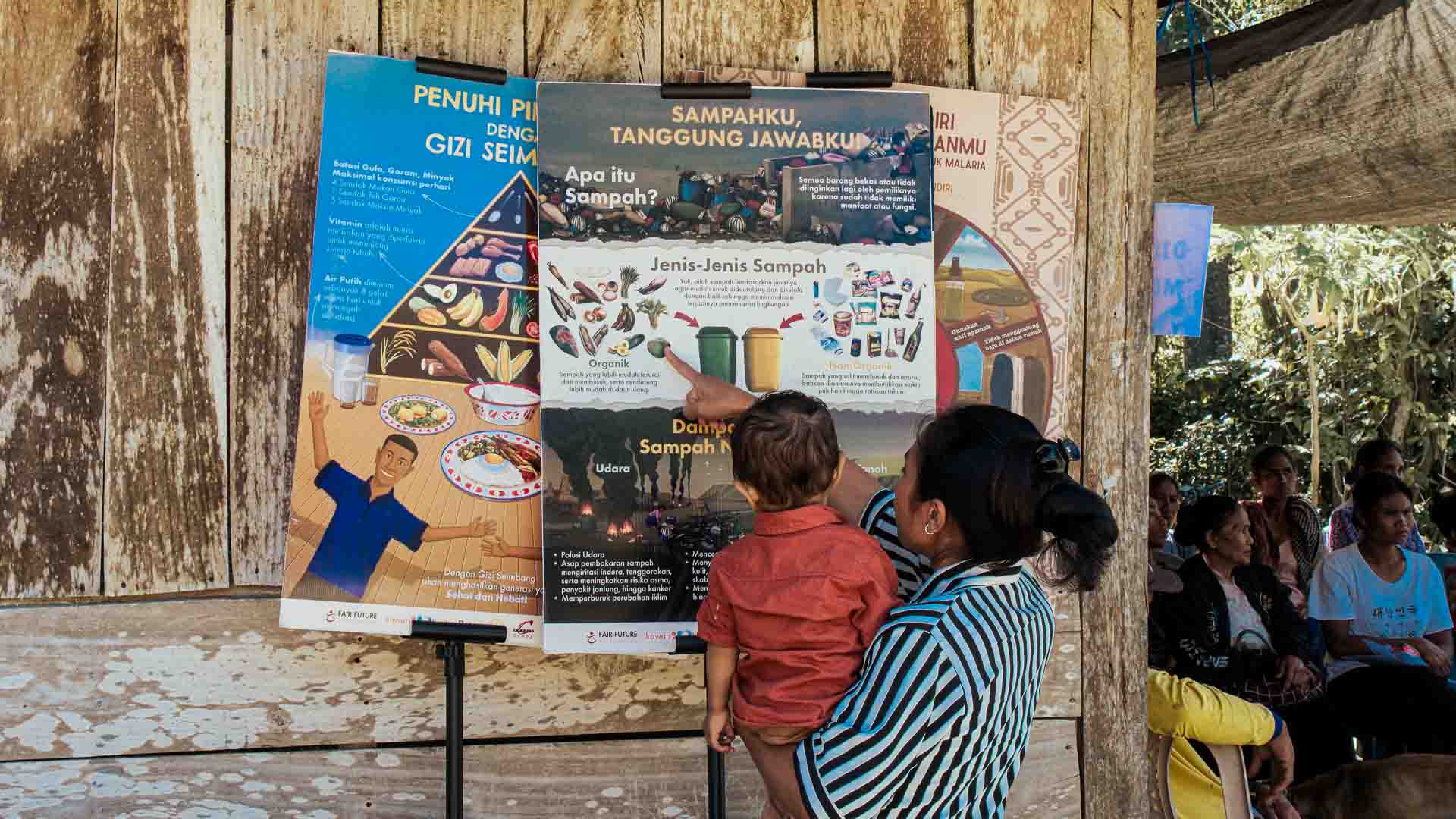
A workshop matters when people can take the message home, explain it again and connect it to decisions in daily life.
Knowledge that can travel
Ten campaigns made for community teaching
Fair Future has produced ten bilingual visual campaigns on hygiene, malaria, nutrition, tobacco smoke, waste, alcohol and HIV. The posters are designed for homes, schools, care days and village discussions. They turn technical guidance into images and language that people can use, question and teach to others.
10 visual campaigns
English and Indonesian posters for repeated, practical prevention work.
150-page health manual
Fourteen structured modules help local health agents learn safe first-line practice.
Offline field apps
Records, follow-up and evidence remain usable where connectivity is unreliable.
Reproducible methods
Construction and maintenance skills are taught through hands-on work with local materials.
What changes in practice
Capacity remains after the activity ends
Infrastructure can be maintained
Residents understand how a tank, water line, building or solar system was made and what routine care it needs.
Care begins inside the community
Trained Kawan Sehat agents recognise danger, provide safe first-line support and organise referral earlier.
Knowledge moves between households
Teachers, parents, agents and young people reuse books, posters and demonstrations in everyday settings.
Evidence reflects lived reality
Household interviews, field records and community feedback help programmes respond to actual barriers rather than assumptions.
Community healthMeet the Kawan Sehat agentsLearn how local women and men become trained first points of care, prevention and referral.
Water & infrastructureWater ConnectionsFollow reservoirs and distribution systems built with communities for local use and maintenance.
10 campaignsCommunity education postersOpen ten bilingual prevention campaigns covering health, hygiene, nutrition and daily risks.
Community evidenceSumba Sepsis Study 2026Explore results built from interviews with 1,001 households and 162 healthcare-worker submissions.
Live field recordField Notes from East SumbaRead short, dated updates on construction, training, prevention, research and local decisions.
Books & field guidesPractical publications to reuseBrowse books, manuals and illustrated guides made for teachers, health agents, children and families.
External referenceWHO community engagement guideRead the international framework for relationships that enable stakeholders to work together for health and well-being.
Live from the field
Community capacity, as it grows
Two recent signals from construction, water, care and prevention in East Sumba. These notes refresh automatically when a relevant Field Note is published.
Directly from the field
Latest Community Empowerment reports
These reports show empowerment in practice: villagers shaping projects, local people learning new roles, infrastructure built together, and knowledge moving through communities.
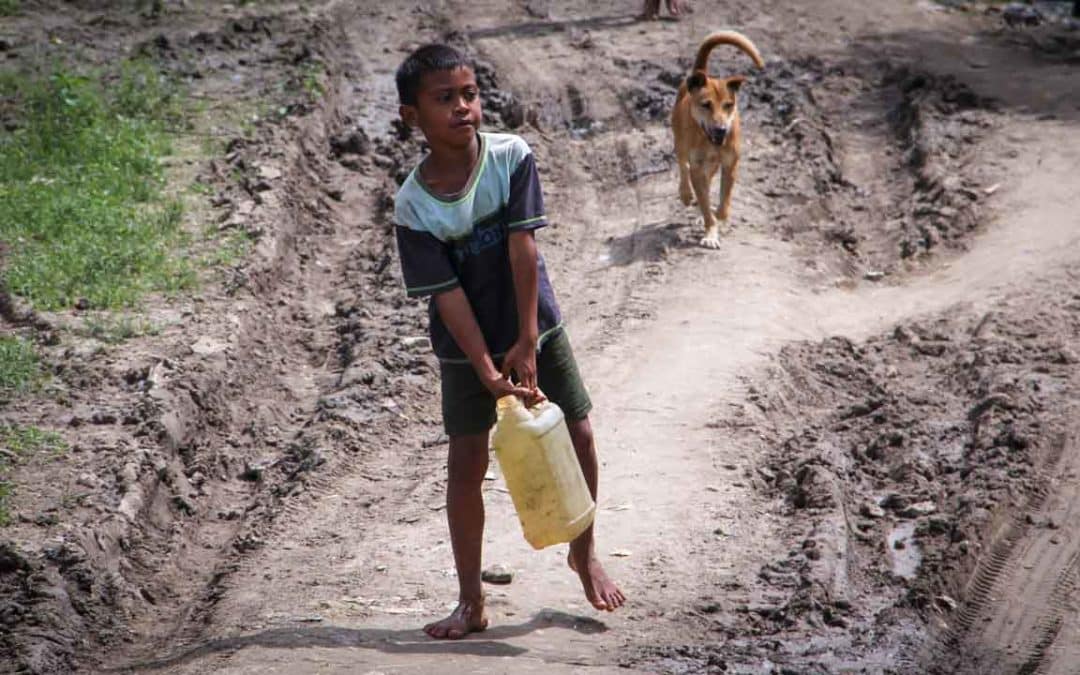
Access to clean water is vital for human health
Children in remote East Sumba often walk long distances carrying water. Better access reduces daily burden and supports safer hygiene and health.
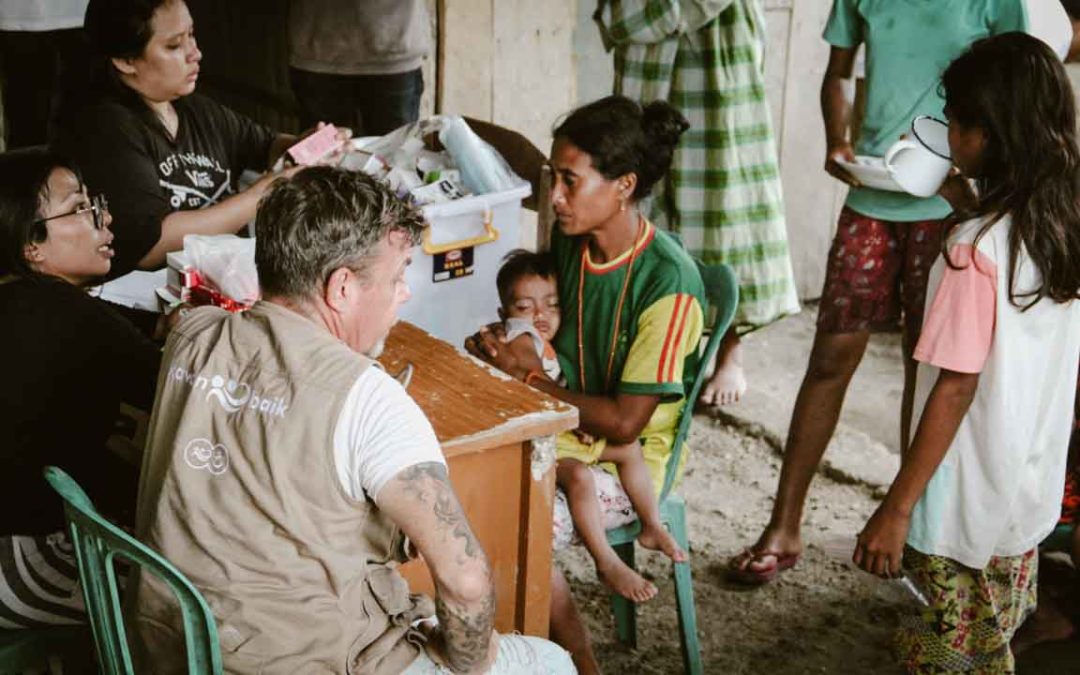
Medical care for children affected by Malaria
A young child with a very high fever and suspected malaria receives initial care before referral to the nearest health centre in rural East Sumba.

PMC program evaluation in Lapinu
These women linked to the PMC program devote part of their lives to saving others. These unsung heroines work tirelessly to keep people from the danger of illness and injury. They put their lives on the line to ensure others can live to see another day.

PMC program evaluation in Kabanda
Kabanda is genuinely one of the most isolated I have ever seen. Getting it is difficult, even dangerous, at times. No road leads to this village; only extremely steep or steep stony paths allow us to go there. It took us over six hours to get there, including four hours of absolute terrain with the Truck of Life, a 4×4 medical truck specially…

PMC program evaluation in Mbatapuhu
Non-professionals who give medical care and medicine to people, sick children, and injured. They do so through a unique and innovative medical care program. Because here, there are no doctors, no health centre, or else too far away. No one has a vehicle, and the roads that lead to these villages are often impassable.

Evaluation of 8 Kawan Sehat agents, in Mbinudita
In the village where it all started for us: The #rebuildmbinudita program is the construction of a school, and the construction of a drinking water network for more than 2700 people, 60% of whom are children under 12 years old . It is really the (re)construction of an entire village or learning to live healthier, healthier all together, within…

PMC program pre-assessment in Mbinudita
Fair Future teams examine and investigate more than two hundred cases of various illnesses or injuries treated under the primary medical care program by health workers. We also take stock of what will happen next week to accurately assess the supply of new equipment, drugs and medical devices.

On-site Primary Medical Care Program Assessment
This primary medical care program in ultra-rural areas, which we initiated and started last year, is extraordinary, it saves lives. Since December 2022, the participants in the primary medical care program – who are the village teachers – have been providing first aid to children and villagers. They treat wounds, diseases, malaria, dengue fever.

Teachers provide primary medical care
The magic of this “Primary Medica Care” program? It’s just that it’s unique in the world and it works. The first batch of sixty teachers who have followed the training in primary medical care in rural areas, tell us about their “exploits” and their work as rescuers. They take confidence in themselves it is the most important, and we note it.

Malaria outbreak in East Sumba, Indonesia
Malaria is one of the most severe public health problems in the world. Here in Indonesia, and especially in the eastern regions, it is one of the leading causes of death and disease. Children under five years old and pregnant women are the most affected groups.

Strong women representing a strong nation
These women play a major role in the rural economy of their village. They are the ones who transport sand for the construction of a new drinking water reservoir on the Mbinudita site. They sing traditional songs to give themselves courage, because it takes a lot.
Accountability
Participation must leave skills, evidence and ownership
We document who decided, what was built or taught, how resources were used, what communities report and what still does not work. A participatory programme must be open to correction and show whether local capacity is genuinely stronger, not simply count meetings or completed objects.
