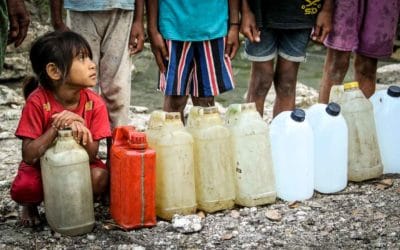


The current priority in this village is to give them clean, safe water and sanitation. Here, families must walk for miles, sometimes more than 10 hours, to bring a few litres of clean water home. People here have less than 2 litres per day and a person to drink, eat, go to the toilets, and wash. So you have to make sacrifices. Malaria is taking its toll here, just like infectious diseases that considerably weaken families' health, especially those of children under five. This is a critical situation for us on a health level. Still, on a social level, Fair Future and Kawan Baik, in collaboration with the local authorities, wish to start a simple Water Connections project in this village as soon as possible.
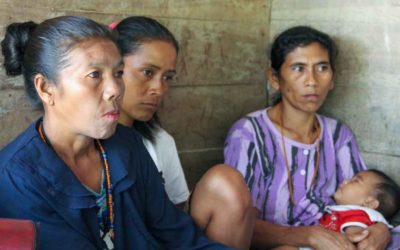
Illness often begins long before someone arrives at the hospital. Our campaigns on smoking, waste management, alcohol, and sexual health display straightforward messages across schools and village walls in local languages. Through simple posters, talks, and games, we help protect thousands of children.
Donate
Support Care
Programs
All projects
Quick News
Field updates
Stories
Field stories
Primary Care and Disease Prevention for All
The Fair Future Foundation is unwavering in its dedication to providing primary medical care, treatment, and disease prevention to strengthen the health and well-being of families, women, and children in vulnerable communities. Through unwavering, sustainable approaches and a relentless focus on clean water, nutrition, and accessible healthcare, we are resolutely committed to creating healthier, more resilient futures for all.
The Health & Medicine category of Fair Future Foundation focuses on bringing essential medical care and health education to ultra-rural Indonesia. We share stories of how our teams work tirelessly to treat illnesses, prevent infectious diseases, and improve community health. These articles highlight the importance of access to healthcare in remote areas and show how medical programs save lives and build healthier futures for those who need it most.
We focus on primary care, treatment and prevention of diseases
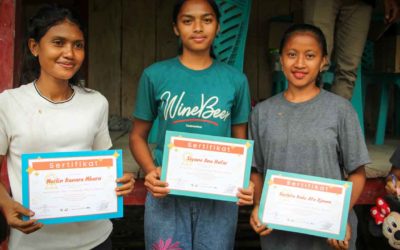
PMC – Teachers receive their training certificate
This new "Picture of the Day" shows three real heroes and three incredible women, Merlin, Siyane and Sarlota. In the ultra-rural and isolated village of Kabanda, the three participants and teachers in the primary medical care program received their first work and training certificate.
This follows the teaching they received from the foundation's teams in December 2022. Complete medical training based on fifteen modules, which explain and demonstrate how to care for a sick or injured patient (adult or child ). This is in villages where no health centre, doctor, or health professional is present, available or accessible, and most of the time, like here in this village, where no road leads.
You must understand the situation, friends: These women come from Asia's most rural regions and perhaps even the world. Most have not been to school or received basic compulsory training. They were trained for three months in teaching in the ultra-rural areas by a partner association called Charis Sumba.
So you have to imagine their pride to have succeeded in becoming one of these health workers, the person in the village responsible for providing first aid in an emergency, the possibility of illness in the event of an injury, an adult or a child. So when they received this certificate, tears flowed. Their tears flowed ours too, and it was a moment of incredible strength, but above all, very emotional.
In principle, here, and related to local culture and traditions, a woman takes care of household chores, fetching water, cooking for the children, and caring for the family. These three female superheroes are not only teachers within the framework of Charis Sumba, but they are also now – and for more than four months – the health workers of the PMC program. They are the ones who can save a life in the absence of a medical centre, medical care or a doctor in the village. This is not anything in terms of enhancing the role of women in ultra-rural villages; this is immense and important progress.
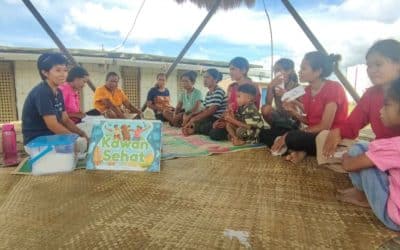
Evaluation of 8 Kawan Sehat agents, in Mbinudita
In the village where it all started for us: The #rebuildmbinudita program is the construction of a school, and the construction of a drinking water network for more than 2700 people, 60% of whom are children under 12 years old . It is really the (re)construction of an entire village or learning to live healthier, healthier all together, within the framework of the creation of innovative programs. Access to primary medical care is part of this program here in Mbinudita and it is only natural that we have included it in this Care program.
PMC program pre-assessment in Mbinudita
Fair Future teams examine and investigate more than two hundred cases of various illnesses or injuries treated under the primary medical care program by health workers. We also take stock of what will happen next week to accurately assess the supply of new equipment, drugs and medical devices. We also tell them that three will be part of a “test” screening program for high blood pressure and, in this case, the “prescription” of treatment and an appropriate medical procedure.
What does a kitchen look like without food or water
This new "Picture of the Day" shows you what the kitchen of an East Sumba family is like. A kitchen like there are tens of thousands here. One of the elements we always see is the presence of five-litre jerry cans. They are the ones that serve as a container for the water that the girls and women have to fetch from afar. We also notice the absence of food, including no rice, only corn. Rice is expensive, and nobody can buy it here in Laindatang, East Sumba: No electricity, running water, and sink.
Just a hearth that will be used once a day only to prepare corn porridge mixed with vegetables and roots that the women have been looking for in the forest. Salt and red peppers. That will be all for the day and the whole family, including dogs and cats.
Families here live without clean or potable water, yet access to potable water is crucial for survival and maintaining good health. Without clean water, families in the areas where Fair Future and Kawan Baik work are forced to drink contaminated water, which leads to waterborne diseases such as cholera, typhoid fever and dysentery.
This has an immense impact on daily life and livelihoods. Women and children must walk long distances to fetch water, which takes up much time and interferes with other activities such as work or education.
Fair Future work in picture albums
Fair Future’s photo albums reveal true stories from the field—captured by our team, in action. See what healthcare, clean water, and human dignity look like in the heart of rural Indonesia.
Inventing toys when you don’t have any
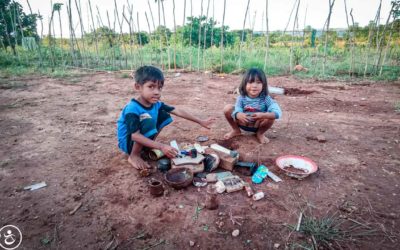
This "Picture of the Day" shows two children from Tanah Mbanas, Sumba Tengah, who have created a kitchen with waste from the plastic they found around their houses made of earth and bamboo. They are playing cooking. Here, families do not have access to water and even less to clean water.
Here in Sumba, in these ultra-rural villages, it is not uncommon for children of all ages to invent toys and games from natural materials or objects from waste or old. In these areas, children rely on their creativity and ingenuity to find new forms of play and have fun.
For example, children can make their toys from natural materials such as sticks, pebbles and leaves. They can use these materials to create games like building forts or playing "tag" with modified rules. Likewise, old items like cans, tires, or ropes can be repurposed to create new toys, like a toy truck, makeshift soccer ball, or swing.
These types of imaginative play experiences are very beneficial for the development of children. They encourage creativity, problem-solving and social interaction as children work together to develop new ideas and adapt the rules of their games. Additionally, playing in nature can provide opportunities for physical activity and exploration, positively affecting physical and mental health.
Primary medical care dedicated to children
This "Picture of the Day" shows children who, thanks to the "Primary Medical Care" programme, learn to protect themselves against illness and injury through simple gestures and habits. Children in these regions do not have access to health centres, and no doctors are present in these villages (apart from those from the Fair Future and/or Kawan baik Indonesia foundations). It makes prevention an essential component of their health and well-being. Children in ultra-rural areas can significantly reduce their risk of illness or injury by incorporating simple habits and actions into their daily routines. In addition, it is essential to make children and parents aware of the importance of these habits and gestures so that they become part of their daily lives.
Giving primary medical care is not insignificant. It usually is doctors and nurses who do this. This is what makes this program unique in terms of innovation. Those who provide care, life-saving drugs and cures for Malaria, for example, are the teachers of this isolated village in eastern Indonesia. Therefore, for us here on site, it is essential to assess the impact and effectiveness of this program regularly. We carry out surveys, and we meet to collect medical data. We, therefore, highlight the areas where we can make the necessary changes. If this primary medical care program is a huge success, it is because it involves the communities in the various planning and implementation processes.
Teachers and parents of ill or injured children provide us with essential information. This 100% medical emergency program is in the process of success. It requires multiple collaborations, adequate ongoing training, sharing of supported cases and regular evaluation to ensure its safety, effectiveness and sustainability.
Malnutrition is taking its toll here where we are
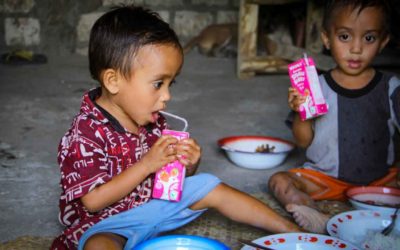
This "Picture of the Day" shows children in East Sumba, where we are at work, as I post this Photo of the Day. Fair Future and Kawan Baik teams, as part of the #kawansehat #primarymedicalcare and #waterconnections projects, cook for children in the most rural and poor areas. In this image, some are drinking strawberry milk for the first time. They had never seen a straw before, and I remember all the kids asking us how to drink that kind of drink. We had to show them and help them plant the straw in the milk carton.
Malnutrition is an endemic problem here in all the rural villages of East Sumba. It is also the region with the highest rate of malnourished children in Indonesia. Here, clean water is absent from the houses, and the consumption of unclean water generates health problems and serious illnesses. And to cook, drink, and wash, you need water. And in order not to get sick, you also need water. Food production cannot occur without water, and families do not have enough income to buy food, rice and vegetables. On average, they live with less than two litres of water per person per day for everything: cooking, eating, drinking, drinking, bathing, going to the toilet and doing laundry. Have you ever tried?
Most children here are underweight and malnourished because they cannot eat enough. Meal frequency is one meal per day. Young children may be able to eat twice if all goes well. The menu will consist of rice and corn because more than rice alone is needed. In East Sumba, a kilo of rice costs three times more than in Java or Bali. Only a little salt and peppers accompany the meal to give flavour and taste.
Kids here have to fetch water from the age of five!
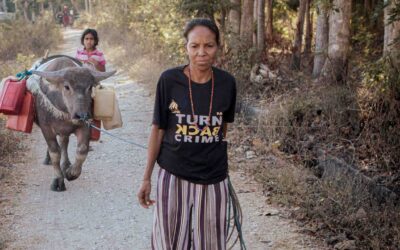
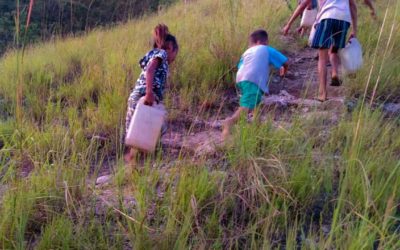
This "Picture of the Day" shows you a five-year-old girl who, twice a day, descends the hill, steep and stony, without shoes to fetch water. She runs to go to the source, 500m away. Sometimes she falls, hurts herself, and comes back up with difficulty carrying a 5-litre jerrycan of not-so-clean water, which she and her friends have been looking for at the source.
In this village, like in many others here, people can only wash once a month, are all sick and don't have enough to eat and drink. Without access to this clean water, families – especially children – suffer from severe malnutrition, chronic respiratory and joint diseases and other illnesses linked to the consumption of dirty water and the absence of sanitation facilities. The fight against malaria, dengue fever and infectious diarrhoea also requires access to clean water and healthy water tanks. And to water that does not stagnate but circulates between the installations.
As we have already said, East Sumba is the poorest province in Southeast Asia, the region with the highest child malnutrition and associated mortality. Fait Future, therefore, wishes to act for these hundreds of people and give them access to clean and healthy water for their health.
Learn how to provide Primary Medical Care
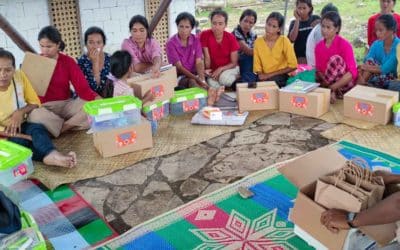
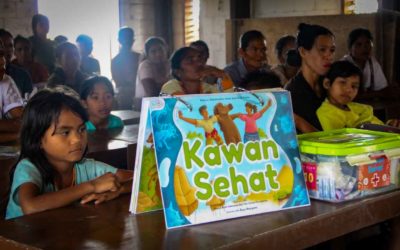
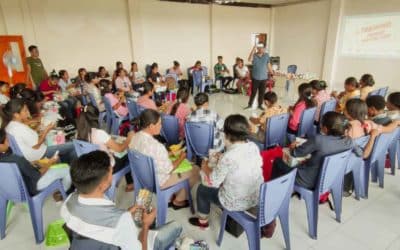
This "Picture of the Day" shows you one of the classes of brave women (and two or three men) who learn with our teams how to give first aid – Primary Medical Care which is the most important – to a person or a sick or injured child.
These first days of medical training welcomed around sixty participants from the most isolated and rural villages. To give you an idea, folks, none of these villages has access to clean or safe water, and only a few have access to some electricity. There is often no road leading there, but only paths that are often impassable. And, of course, no medical centre or health centre near the villages.
The participants are 95% women, and all are teachers in the school of their ultra-rural region. What they have been doing for a few months now is remarkable. They heal and undoubtedly save lives, see here some images taken with their mobile phone.
Aside from being most undoubtedly unique in the world, the magic of this "primary medical care" program is that it works. The first batch of about 60 teachers who have undergone training in rural primary medical care are now gaining more and more confidence, and hundreds of urgent medical care are being provided to the children of sick or injured adults. Lives are being saved.
In a few days, Fair Future Foundation with Kawan Baik Indonesia will evaluate this program directly from the villages, in the company of those who are its heroes, all these extraordinary women.
A simple jerrycans story in East Sumba
Two litres of water per day and per person to live. And this, thanks to an object as innocuous as an old five-litre can. A stupid plastic container? For most of us, it is an object that will go irretrievably in the trash. But here, for the families that Fair Future and Kawan Baik work with – tens of thousands of families – it is essential to the survival of an entire family because it is thanks to him that these two litres of water will come home. So, let’s talk a bit about plastic canisters, if you don’t mind, to understand why it’s so important.