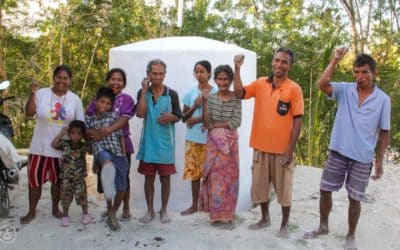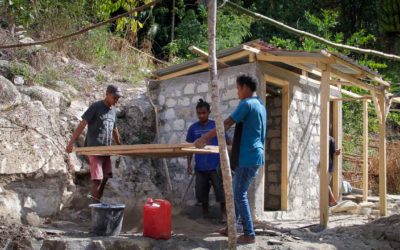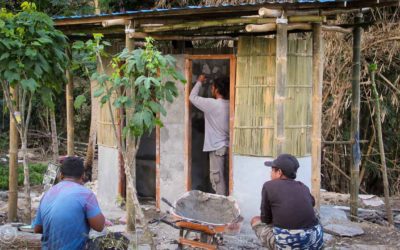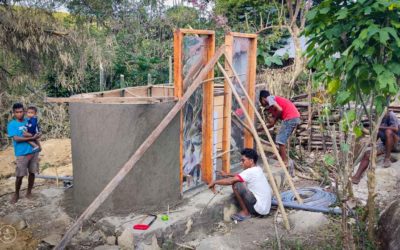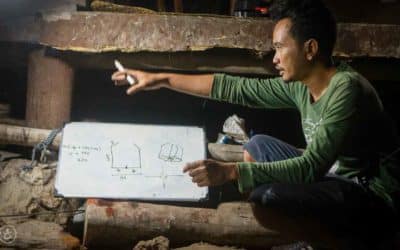


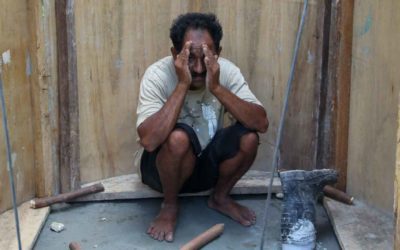
In rural villages in eastern Indonesia, where we work, toilets are very rare. This is particularly a problem in rural areas where a third of the population must continually defecate in the open air. For Bapak Rinto, it is a relief and a great pride that his family finally has a toilet, thanks to the support of Fair Future and Kawan Baik Indonesia.
Malaria continues to pose a daily threat in this area. Through Kawan Against Malaria, we monitor cases, test all fevers, protect homes, and educate families. The use of bed nets, spraying, and prompt treatment turns statistical data into lives that endure quietly, rather than ending prematurely.
Promoting safe sanitation practices to protect health and prevent disease in rural communities.
Water Connections from the sky – 04 October 2022
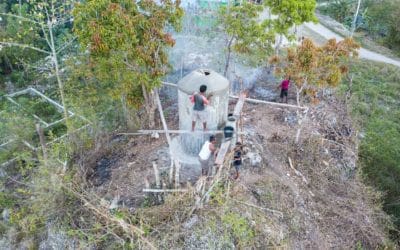
The health burden of poor-quality water is enormous, and providing clean water to such a large population is a considerable challenge. Indonesia, particularly the east of this immense country, is characterized by a non-uniformity in the level of awareness and socio-economic development. Therefore, our two foundations do what they can. These few images are taken from the sky and show you what this major project consists of, Water Connections: Drinking water and sanitation for 2,500 people.
Water Connections program, the work of teams in the field
The past few weeks have been hectic for all of us here in East Sumba. What a titanic job we are all doing with the help of our friends, the villagers, and members of the rural communities of Mbinudita. The nights are short, and the days are very long and hot too. Imagine, friends, it’s almost 40°, and we work under a blazing sun, which almost anaesthetizes us if we don’t hydrate ourselves enough.
Building two new Water Tank – East Sumba, Mbinudita
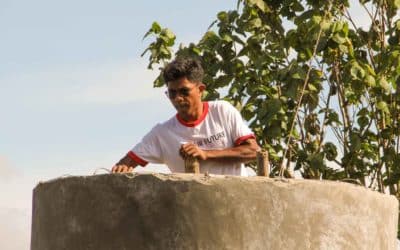
In these few images, the teams of Kawan Baik Indonesia and Fair Future Foundation, with the help of volunteers from the village, are building two new Ferro-cement tanks of more than 6000 litres, which in a few weeks will provide clean water to a group of houses. In all, a good thirty families here in the village of #Mbinudita, where our #sdmbinudita school is located.
Living without toilets and without water, Fair Future is changing that
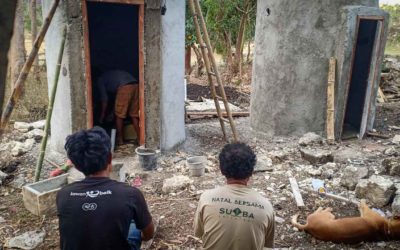
We are in the process of completing new clean water tanks and new sanitation facilities in Mbinudita. Our teams are on-site with the help of the entire local community, women, men and children who help us in this work. These infrastructures are made of Ferro-cement, like all the others, with the difference that we give the possibility to the villagers to choose the type of construction. Once again, this type of collaboration works wonders on site because it allows everyone to learn and work.
Benefits of Clean Water in life
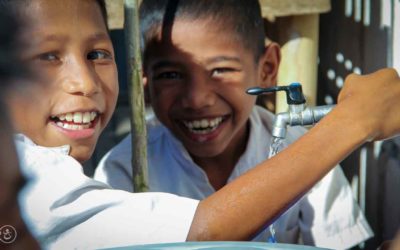
The Benefits of Clean Water Influence the Daily Lives of Children and Adults and Impact the Quality of Life in a Community for Generations to Come. Fair Future sees a change in the habits of families who benefit from the Water Connections program. Without drilling deep wells here, families will not be able to access clean water and will have to continue walking for miles and hours to fetch dirty, unsanitary water. Most of the time, women and children are assigned to this exhausting task. Access to better health has always been the foundation’s primary mission, and healing people simply by giving them water is incredible for us. It is the only possible solution.
Drinking and eating better thanks to water connections
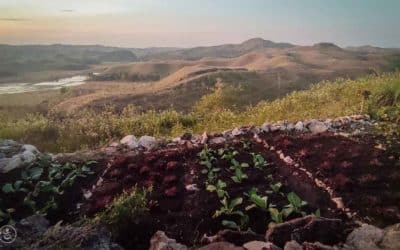
For months, Fair Future has noticed a fundamental change in habits in families who benefit from the “Water Connections” program. Gardens are created. People eat better, drink more, have more energy and are less ill. This observation fills us with joy and comforts us in our choices and decisions. Access to better health has always been the foundation’s primary mission, and healing people just by giving them water is incredible for us.
The 2nd sanitary facility of the village is almost finished
Although access to clean water continues to be a problem, it isn’t easy to ensure it is safe. In this sense, Fair Future is putting in place measures to ensure that it is sustainable. By tests, of course, filtration systems that use elements present in nature. But also, and above all, the education of users on “how to keep the installation clean and in optimal working order” is part of the “water Connections” program. On the other hand, it should be noted that individual practices also play an essential role in determining the quality of the water that we make available to the villagers here in East Sumba.
We create water connections, look…
The first idea was to treat people at the source of their health problems because our medical teams and us allow the expression: “-We were a little tired of giving medicine with a glass of inedible water. …”. And as we have told you many times before, the vast majority of patients who come to us are primarily because of the poor quality of the water they use. But also because they simply don’t have enough or no water.
The 1st toilets of the village are almost finished
Sanitary facilities, showers, toilets, a wastewater collection tank… This was a pilot project for the foundation. Today it is something normal. How do we build healthy, ecological, environmentally friendly sanitary facilities using mainly local materials (apart from sand, iron and cement)? How not to waste the water we found by drilling so deep here in Mbinudita? Where had drilling never been attempted? How to reuse wastewater to be able to water the gardens, the plants, and the vegetables that do so much good to and improve the lives of everyone here? It was a challenge, but it is now a reality.
Building healthy sanitation facilities in rural areas
We are building safe and healthy sanitation facilities for these reasons: Ending defecation in the open rather than in toilets will have “transformational benefits” for the most vulnerable people in East Sumba. Open defecation is when people defecate in the open -for example, in fields, forests, bushes, lakes and rivers rather than toilets. We find that of the hundreds of thousands of people who practice open defecation, 91% live in rural areas. An increase in the population of the regions in which we work leads to a localized increase in open defecation.
Building a 6,500-litre Ferro-cement tank
Building a water storage tank is something simple but complicated at the same time. Working day and sometimes night too, sleeping under challenging conditions, eating little and walking a lot… This is the life of the Fair Future and Kawan Baik teams in the field, every day for months with the support and unconditional support of the villages where we are setting up a new program. We are very involved in all the constructions, be it the reservoirs but also the healthy sanitary installations, the water connections, the filtration systems, and so many other things which, put together, create infrastructures which make them more useful, simpler life.