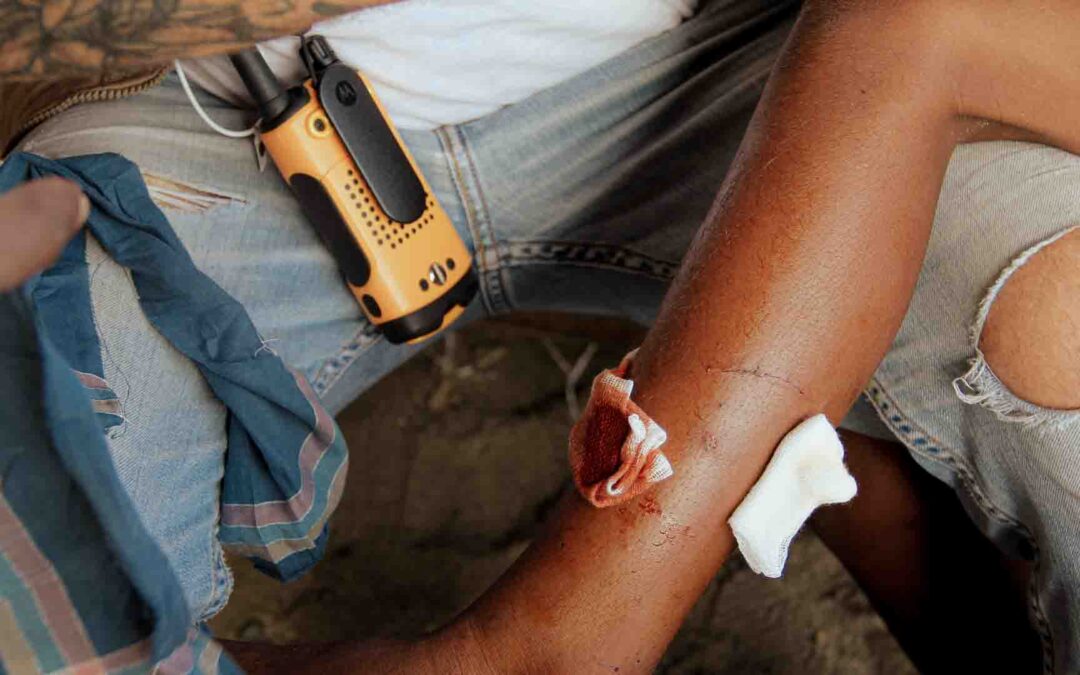
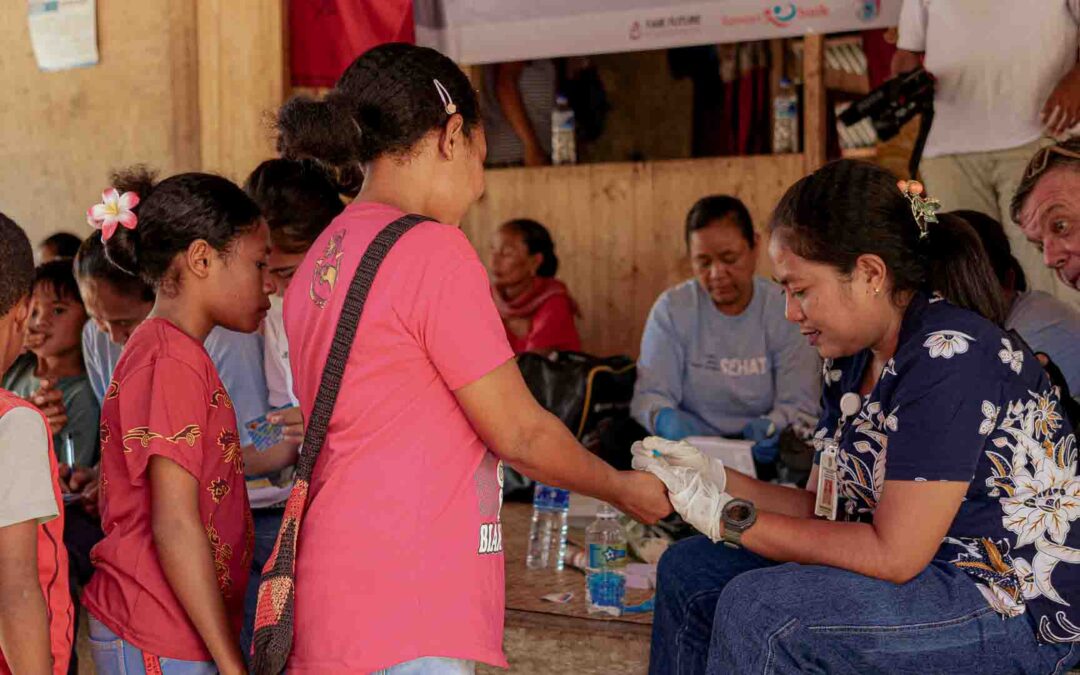
We’ve invested in a new scooter for Erwin, our Primary Medical Care field coordinator. This off-road-capable scooter will help Erwin reach even the most remote Kawan Sehat health agents to deliver and restock medical supplies. It’s a small investment of 1,000 Swiss francs, but one that will undoubtedly save lives.
We have compiled a list of articles and pages for this topic
The Fair Future Foundation in East Indonesia combats social and medical injustice and aims to ensure everyone has access to healthcare, clean water, and education. Join us in making a difference.
Fair Future’s mission: to provide basic medical care and treatment in areas with no healthcare infrastructure.
Local Impact: Fighting Malaria with Prevention and Care
The Fair Future Foundation and Rotary International have launched the Zero Malaria Program to combat malaria in remote Indonesian regions. Our efforts include distributing insecticide-treated nets, conducting rapid diagnostic tests, and educating families on disease prevention.
Updated Kawan Sehat Manual for Health Agents
The training manual for Kawan Sehat health agents in the #PrimaryMedicalCare program, containing 14 modules over 150 pages, will be reprinted after revisions and additions. New modules will enhance the training to ensure these agents can fully address the needs of those who lack access to medical care in their remote areas.
Sustainable Backpacks for Medical Kits by Fair Future
For our #PrimaryMedicalCare program, the Swiss Foundation has decided to replace plastic medical kits with sustainable and eco-friendly backpacks made from recycled materials. These sturdy bags can store and transport all the necessary medical equipment. Decorated with a simple red cross, it is also our way of paying tribute to the ICRC.
15th Anniversary: A Decade and a Half of Action and Healing
Celebrate with us as we mark 15 years of the Fair Future Foundation’s unyielding commitment to providing essential medical care, clean water, and hope to rural communities in East Sumba. Founded by Alex Wettstein, our dedicated team has been at the forefront of combating infectious diseases, addressing hunger, and improving living conditions for…
Revolutionizing Rural Health with #PrimaryMedicalCare
Experience the transformative power of Fair Future Foundation’s #PrimaryMedicalCare program. Witness first-hand how our pioneering initiative is revolutionizing healthcare in Eastern Indonesia’s most isolated regions. Our community-driven solutions and dedicated Kawan Sehat health agents are bringing sustainable health improvements and hope to…
Donate Now: ZeroMalaria’s Urgent Fight in Eastern Sumba
The rainy season is weeks away and malaria cases in Eastern Sumba are about to rise sharply. Fair Future’s ZeroMalaria program urgently needs your donation for crucial medical supplies like diagnostic kits and antimalarial medications. Your support directly equips our medical teams and saves lives. Act now.
Kawan Sehat: Transforming Healthcare in Rural Indonesia
Kawan Sehat healthcare workers are doing more than just transforming healthcare; they are saving lives in the most remote areas of Indonesia. These amazing women provide vital medical care, overcome obstacles, and challenge traditional gender roles in their communities.
Sepsis in Rural Indonesia | Fatal Delays
Sepsis in rural Indonesia often begins with a treatable infection and ends in preventable death. This article presents a new East Sumba field study to understand delays, danger signs, referral barriers, and the role of community-based care.
Kullup is a hole in the rock to collect rainwater
This new "Picture of the Day" shows you kids from the village of Laidatang, who fetch water far from home in the "Kullup" of the village. Elthon, responsible for documentation (with the black t-shirt), and Alex, from the medical staff, are also present in this photo. With the kids and one or two adults accompanying us, we walk more than an hour to reach this place in the middle of a high hill. You must descend a steep path to access these hand-dug holes in the rock. In 30 minutes, we will have to go up the hill and walk back. But this time, loaded with several jerrycans filled to the brim.
The Fair Future and Kawan Baik teams spend two days with the families of the ultra-rural and isolated village of Laindatang to get to know them even better. In this village, we have the project to create a #WaterConnections project. I let you read here the articles related to this project and here to see what your want to do to save their lives,
In Laindatang, families only have access to rainwater. It's for everything: eating, drinking, cooking, bathing, washing clothes, drinking water, caring for children, sick people or watering animals. Therefore, one of the ways for women and young girls to have water at home to live on is to walk several kilometres to find the "Kullup".
Kullup, what is it? These are small stone basins, directly dug into the rock by the villagers, used to collect and store rainwater in rural areas. When it rains, the water seeps into the ground at the top of the hill and then is filtered through the earth and the basements. It flows drop by drop in these stone basins, the "Kullup". Then the villagers come to fill their jerrycans with five or ten litres.
The "Kuluk" are an essential water source for the local communities. But the quality of stored water can be affected by bacterial contamination, chemicals, animal waste or debris. Therefore, regularly cleaning these small holes in the rock is essential to maintain water quality. It is important to note that the "kuluk" is only a temporary solution to the water crisis in areas with limited access to drinking water. Indeed, the "kuluks" cannot fill up correctly without rain. They dry out about ten days after the last rains and remain dry for almost nine months. To find water, young girls, women and children, sometimes under five, will have to walk even further and longer.
Our two organizations work with local communities to implement longer-term solutions, such as constructing water supply networks using deep boreholes and sealed and healthy rainwater cisterns. The Water Connections program offers innovative and sustainable solutions. It includes promoting water conservation practices with “Kawan Sehat” and self-sustaining access to Primary Medical Care through the PMC program.
East Sumba Sepsis Study | Fatal Infection Pathways
Fair Future Foundation and Kawan Baik Indonesia launch the East Sumba Sepsis Study in May 2026. Nearly 500 household interviews and healthcare worker questionnaires will document why severe infections become fatal in ultra-rural villages, before better detection and care can be built.
Health Built Before Patients Arrive | Rural Medicine
Health built before patients arrive explains why prevention determines survival in rural regions. Clean water systems, malaria prevention, community health agents and early detection reduce infections and save lives long before a patient reaches a clinic.