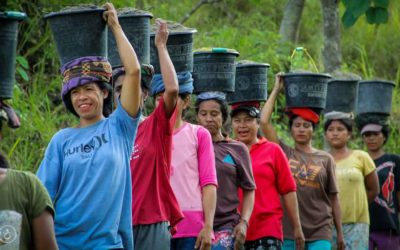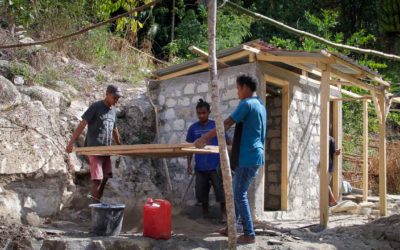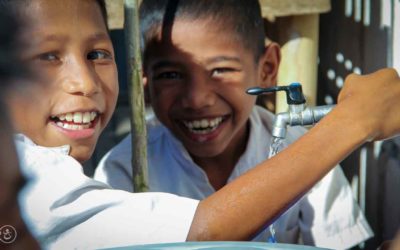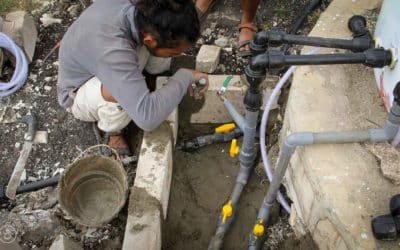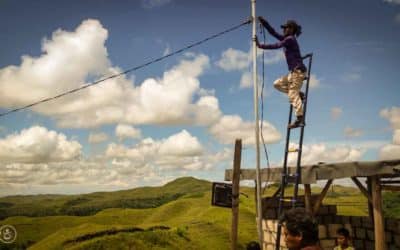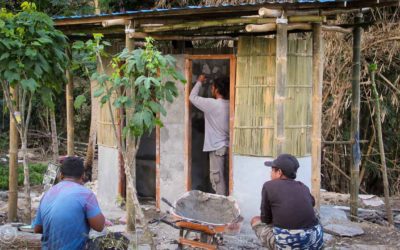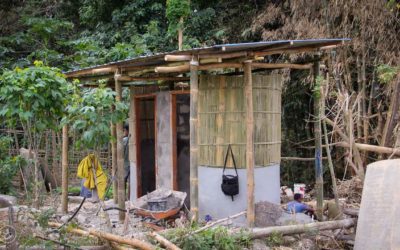


For a few months -thanks to the Water Connections programâ, the families are feeling healthier, happier and have much more energy. The villagers, who are 100% farmers, are much less sick, and they are in better health. Vegetable gardens are created, and an economy is built. Women and children spend much less time fetching water from wells far from homes. As a result, children spend more time in school, and adults have more time to do things they couldnât do before. On the other hand, water remains the absolute priority of each of the 250 families of #mbinudita, well before everything else! Today, we are building healthy sanitary facilities for the village and the villagers. Like all other families living in ultra-rural areas, people have never had access to toilets or a place to bathe or do laundry.
Illness often begins long before someone arrives at the hospital. Our campaigns on smoking, waste management, alcohol, and sexual health display straightforward messages across schools and village walls in local languages. Through simple posters, talks, and games, we help protect thousands of children.
Donate
Support Care
Programs
All projects
Quick News
Field updates
Stories
Field stories
Process of manufacturing healthy sanitary facilities in East Sumba
For the past two months, we have been on the Mbinudita site
Our teams have been on the SD Mbinudita site for two months for the Water Connections project, clean, safe and clean water for all. The Mbinudita school is the centre of life for an entire region, where more than 2,500 people live, divided into nearly 250 families, the vast majority of whom are children. The social, technical, medical and logistics staff and documentalists have been working for several months on the realization of this unique project. The Water Connections program connects groups of houses and an entire population to clean water connections, sometimes houses more than three kilometres apart from each other. This uses buried pipes, 6500-litre tanks, healthy sanitary facilities, and our boreholes. The innovation is that we mainly use gravity, iron and cement for the construction.
Lukukamaru Sumba. A tremendous job to do here
East Sumba is full of villages that I believe we have to call “very poor”, where eating or drinking enough, taking a simple shower, and earning enough to buy a little rice is almost impossible. These villages are isolated from everything and everyone. We go there as often as possible, currently every day. These moments spent with the villagers tell us very clearly about what we can put in place to improve the living conditions of these people living in these regions. Lukukamaru is one of those villages. Everything is paid for at a high price, at the cost of incredible physical and psychological effort; here, we can speak of a state of daily survival.
Shortage of clean, safe drinking water
All these people, we meet every day. When we ask them what their biggest dream is, all without exception answer us this: To have clean water, some not dangerous for their health and that of children, and pregnant women. To have access to it here, close to home. To be able to water and cultivate a garden, eat better, shower, and wash. But above all to be able to drink more, cook more. The Fair Future and Kawan Baik foundations within the framework of the Water Connections project, strive by all means to fulfil their dreams. Their lives, their health and their future are at stake. Water is the source of life, of all life!
We carried out our first deep drilling with our own machine
Until last week, the 264 students of this school in East Sumba had no water in their school. As you can imagine, this posed unexpected sanitary problems for all the children, the teachers and the houses in the surrounding area. Fair Future has therefore decided to drill a deep well at the back of the school, and we have, thanks to our detection tools, found clean and clear water at a depth of almost 40 meters. A massive change for this community and the people who live nearby. Indeed, they will also be able to come and get water from this new deep well.
Khris Praing, Bupati of East-Sumba to Mbinudita site
The Mbinudita school is now an official school, which falls within the bosom of the schools of the Indonesian state. A huge ceremony that took more than 4 days of preparation took place on June 25, 2022 on the #sdmbinudita school site. In the presence of the Regent of East Sumba, Drs. Khristofel Praing and a number of officials, we have been able to visit the facilities already in place and built as part of the clean water access project for more than 2,500 people. Doing it on a motorcycle with the Bupati was exceptional!
Podcasts – With their words, their voices, in their languages
With their words, their voices, in their using their languages. As part of our fieldwork, our two foundations meet thousands of people from the most challenging regions of Indonesia. People tell us about their lives, their wounds, their difficulties, their joys and their sorrows, and their work. The lack of everything sometimes. Our two organisations try to respond to the lack of food, water, medical care, state aid, and so many other issues every day. All audio recordings were made by Kawan Baik Indonesia, Fair Future and their teams on the ground. Testimonials, project feasibility studies, specific case studies, internal podcasts made available to everyone, the analysis of a particular case, a typical story of life, or a medical issue for which we all want to find a solution.
Days of medical care in rural areas
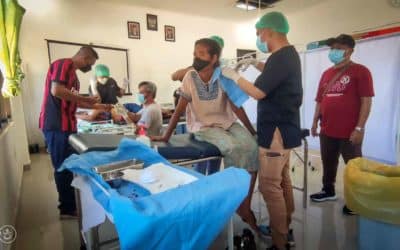
Discover the different contexts and situations in which Fair Future teams intervene to provide care, including crisis and natural disaster situations, and how and why we adapt our activities to each. Days of care like the one we present to you below we do dozens of them a year and they are adapted to people from rural areas, who for the most part have never seen a doctor before us.
Documentation
Access Fair Future Foundation’s official and legal documentation, such as our ethics charter, financial reports, mission statement and visual materials. This webpage offers complete information on our rules & regulations, transparency principles as well as safeguarding the communities we cater to . Navigate through significant resources that outline how we function efficiently in making a difference.
Fair Future’s Mission: Health, Education, and Vital Resource
For over 15 years, the Fair Future Foundation has provided healthcare, education, and vital resources to rural areas. Our goal is to promote self-sufficiency and sustainable development by collaborating with local partners.
Other big challenges for our teams on the way to NTT
Notice of departure of the members of our field teams, for the following programs: The program water connections, clean & safe water in rural areas – Collection of data related to the living conditions of families in rural areas – Provide basic emergency care to all children, with a first aid kit for each school/village – Basic health and medical care in very remote areas – Improvement of logistical means in the event of emergencies and disasters – Start-up of the Program linked to our new deep well drilling rig. Fair Future Foundation and all the collaborators who make it live offer medical, social, educational, logistical, and infrastructural assistance to people affected by shortages, epidemics, disasters, or exclusion from health care. With Kawan Baik Indonesia, we operate in the most rural and ultra-peripheral areas of Indonesia. Fair Future in the field, these are teams made up of health professionals – all local -, logistics and administrative staff, also recruited locally. Our actions are guided by medical ethics and the principles of impartiality, independence, and neutrality. We do not employ foreigners, we empower local resources and it is we who implement actions on the ground, without intermediaries. This is what makes Fair Future and Kawan Baik unique